


Page 264 - Separation process engineering
P. 264
operating at 5.0 atm. The column has a total condenser and a partial reboiler. The feed flow rate is
                             1000 kmol/h. The feed is a saturated liquid. Feed is 8.0 mol% ethane, 33.0 mol% propane, 49.0
                             mol% n-butane and 10.0 mol% n-pentane. The column has 4 equilibrium stages plus the partial
                             reboiler, which is an equilibrium contact. Feed is on 2nd stage below total condenser. Reflux
                             ratio L /D = 2.5. Distillate flow rate D = 410 kmoles/hr. Develop the mass balance and
                                    0
                             equilibrium matrix (Eq. 6-13) with numerical values for each element (A, B, C, and D). Do this
                                                                                                                   j
                                                                                                                       j
                                                                                                               j
                                                                                                                                j
                             for your first guess: T = bubble-point temperature of feed (use same temperature for all stages); K
                                                     j
                             values are from DePriester chart; L and V are CMO values. Do the matrix for propane only.
                        D3. Do the matrix for n-butane for Problem 6.D2.
                        D4. A distillation column is separating 100 kmol/h of a saturated liquid feed that is 30 mol%

                             methanol, 25 mol% ethanol, 35 mol% n-propanol, and 10 mol% n-butanol at a pressure of 1.0
                             atm. The column has a total condenser and a partial reboiler. We want a 98.6% recovery of i-
                             propanol in the distillate and 99.2% recovery of n-propanol in the bottoms (but realize that this
                             first trial will not provide this amount of separation). Operation is with L/D = 5, D = 60, N = 4,
                             and N feed  = 3 (#1 = total condenser and #4 = partial reboiler), set up the mass balance matrix Eq.
                             (6-13) for the first trial for n-butanol, and then solve. This is a hand calculation.

                             a. Use CMO to estimate liquid and vapor flow rates in the column for the first trial. Report these
                               flow rates.
                             b. For a first guess of K values, assume the K values in the column are constant and equal to those
                               found in a bubble-point calculation for the feed. The K  values are (y/x)  where y  and x              np
                                                                                                                  np
                                                                                             np
                                                                                                                             np
                               are from the bubble-point calculation with constant alpha, Eq. (5-30). The other K = α K .
                                                                                                                                    np
                                                                                                                                 i
                                                                                                                            i
                             c. Calculate all the A, B, C, and D values (but for n-butanol only) and write the complete matrix.
                             d. Solve the n-butanol matrix using the Thomas algorithm and find the n-butanol flow rates l
                                                                                                                                    j,n-
                                      leaving each stage.
                               butanol
                             e. The T implicitly used in the calculation to find the K values is the bubble-point temperature of
                               the feed. To determine T, first calculate the K value for n-propanol as (y/x)        n-propanol  where y and
                               x are found from the constant relative volatility solution for the bubble-point. Then use Raoult’s
                               law to find the T that gives this K value. Report this T.

                               Do not do additional trials.
                             System properties: If we choose n-propanol as the reference, the relative volatilities are methanol
                             = 3.58, ethanol = 2.17, n-propanol = 1.0, and n-butanol = 0.412. These relative volatilities can be
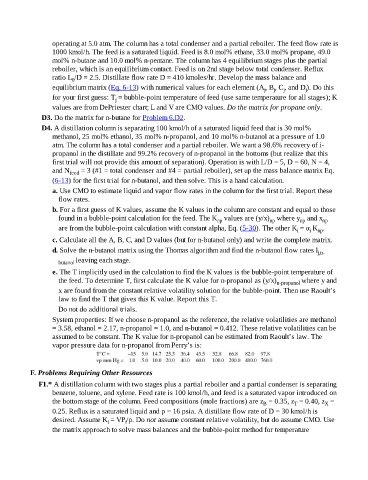
                             assumed to be constant. The K value for n-propanol can be estimated from Raoult’s law. The

                             vapor pressure data for n-propanol from Perry’s is:


                    F. Problems Requiring Other Resources

                       F1.* A distillation column with two stages plus a partial reboiler and a partial condenser is separating
                             benzene, toluene, and xylene. Feed rate is 100 kmol/h, and feed is a saturated vapor introduced on
                             the bottom stage of the column. Feed compositions (mole fractions) are z  = 0.35, z  = 0.40, z  =
                                                                                                               B
                                                                                                                                       X
                                                                                                                           T
                             0.25. Reflux is a saturated liquid and p = 16 psia. A distillate flow rate of D = 30 kmol/h is
                             desired. Assume K = VP/p. Do not assume constant relative volatility, but do assume CMO. Use
                                                         i
                                                  i
                             the matrix approach to solve mass balances and the bubble-point method for temperature

