


Page 256 - Separation process engineering
P. 256
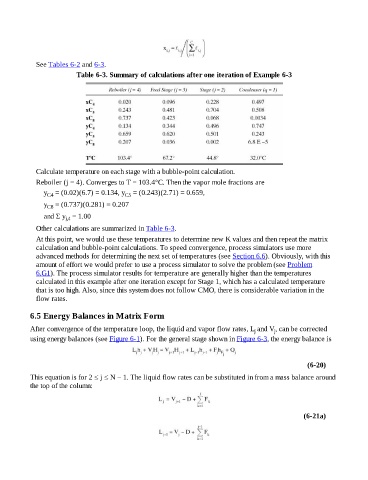
See Tables 6-2 and 6-3.

                                      Table 6-3. Summary of calculations after one iteration of Example 6-3


                      Calculate temperature on each stage with a bubble-point calculation.

                      Reboiler (j = 4). Converges to T = 103.4°C. Then the vapor mole fractions are
                         y  = (0.02)(6.7) = 0.134, y  = (0.243)(2.71) = 0.659,
                                                         C5
                           C4
                         y  = (0.737)(0.281) = 0.207
                           C8
                         and Σ y  = 1.00
                                  i,4
                      Other calculations are summarized in Table 6-3.

                      At this point, we would use these temperatures to determine new K values and then repeat the matrix
                      calculation and bubble-point calculations. To speed convergence, process simulators use more
                      advanced methods for determining the next set of temperatures (see Section 6.6). Obviously, with this
                      amount of effort we would prefer to use a process simulator to solve the problem (see Problem
                      6.G1). The process simulator results for temperature are generally higher than the temperatures
                      calculated in this example after one iteration except for Stage 1, which has a calculated temperature
                      that is too high. Also, since this system does not follow CMO, there is considerable variation in the
                      flow rates.


                    6.5 Energy Balances in Matrix Form


                    After convergence of the temperature loop, the liquid and vapor flow rates, L and V, can be corrected
                                                                                                                   j
                                                                                                            j
                    using energy balances (see Figure 6-1). For the general stage shown in Figure 6-3, the energy balance is


                                                                                                                                (6-20)

                    This equation is for 2 ≤ j ≤ N − 1. The liquid flow rates can be substituted in from a mass balance around
                    the top of the column:


                                                                                                                               (6-21a)

