


Page 252 - Separation process engineering
P. 252
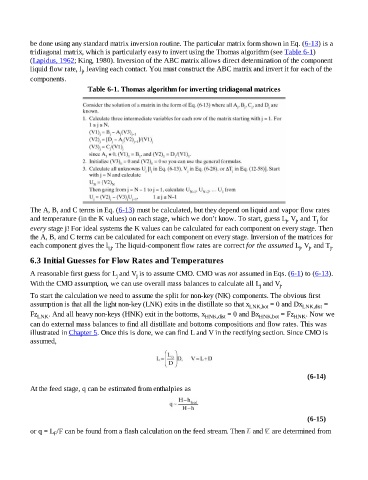
be done using any standard matrix inversion routine. The particular matrix form shown in Eq. (6-13) is a
                    tridiagonal matrix, which is particularly easy to invert using the Thomas algorithm (see Table 6-1)
                    (Lapidus, 1962; King, 1980). Inversion of the ABC matrix allows direct determination of the component
                    liquid flow rate, l , leaving each contact. You must construct the ABC matrix and invert it for each of the
                                        j
                    components.

                                           Table 6-1. Thomas algorithm for inverting tridiagonal matrices


                    The A, B, and C terms in Eq. (6-13) must be calculated, but they depend on liquid and vapor flow rates

                    and temperature (in the K values) on each stage, which we don’t know. To start, guess L, V, and T for
                                                                                                                        j
                                                                                                                            j
                                                                                                                                    j
                    every stage j! For ideal systems the K values can be calculated for each component on every stage. Then
                    the A, B, and C terms can be calculated for each component on every stage. Inversion of the matrices for
                    each component gives the l . The liquid-component flow rates are correct for the assumed L, V, and T.
                                                                                                                                         j
                                                                                                                             j
                                                                                                                                 j
                                                   i,j
                    6.3 Initial Guesses for Flow Rates and Temperatures
                    A reasonable first guess for L and V is to assume CMO. CMO was not assumed in Eqs. (6-1) to (6-13).
                                                      j
                                                             j
                    With the CMO assumption, we can use overall mass balances to calculate all L and V.
                                                                                                              j
                                                                                                                      j
                    To start the calculation we need to assume the split for non-key (NK) components. The obvious first
                    assumption is that all the light non-key (LNK) exits in the distillate so that x      LNK,bot  = 0 and Dx LNK,dist  =
                    Fz LNK . And all heavy non-keys (HNK) exit in the bottoms, x        HNK,dist  = 0 and Bx HNK,bot  = Fz HNK  . Now we
                    can do external mass balances to find all distillate and bottoms compositions and flow rates. This was
                    illustrated in Chapter 5. Once this is done, we can find L and V in the rectifying section. Since CMO is
                    assumed,


                                                                                                                                (6-14)

                    At the feed stage, q can be estimated from enthalpies as


                                                                                                                                (6-15)
                    or q = L /F can be found from a flash calculation on the feed stream. Then   and   are determined from
                             F

