


Page 253 - Separation process engineering
P. 253
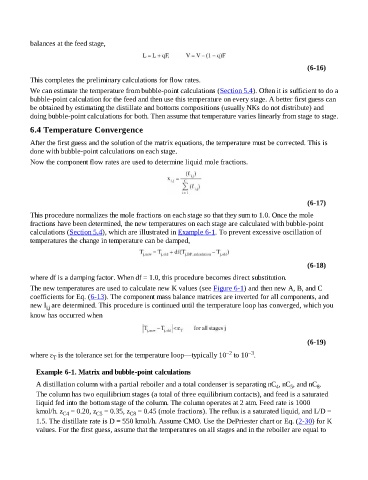
balances at the feed stage,


                                                                                                                                (6-16)

                    This completes the preliminary calculations for flow rates.
                    We can estimate the temperature from bubble-point calculations (Section 5.4). Often it is sufficient to do a

                    bubble-point calculation for the feed and then use this temperature on every stage. A better first guess can
                    be obtained by estimating the distillate and bottoms compositions (usually NKs do not distribute) and
                    doing bubble-point calculations for both. Then assume that temperature varies linearly from stage to stage.

                    6.4 Temperature Convergence

                    After the first guess and the solution of the matrix equations, the temperature must be corrected. This is
                    done with bubble-point calculations on each stage.

                    Now the component flow rates are used to determine liquid mole fractions.


                                                                                                                                (6-17)

                    This procedure normalizes the mole fractions on each stage so that they sum to 1.0. Once the mole
                    fractions have been determined, the new temperatures on each stage are calculated with bubble-point
                    calculations (Section 5.4), which are illustrated in Example 6-1. To prevent excessive oscillation of
                    temperatures the change in temperature can be damped,


                                                                                                                                (6-18)

                    where df is a damping factor. When df = 1.0, this procedure becomes direct substitution.

                    The new temperatures are used to calculate new K values (see Figure 6-1) and then new A, B, and C
                    coefficients for Eq. (6-13). The component mass balance matrices are inverted for all components, and
                    new l  are determined. This procedure is continued until the temperature loop has converged, which you
                          i,j
                    know has occurred when


                                                                                                                                (6-19)

                                                                                                 –2
                                                                                                         –3
                    where ε  is the tolerance set for the temperature loop—typically 10  to 10 .
                             T
                      Example 6-1. Matrix and bubble-point calculations

                      A distillation column with a partial reboiler and a total condenser is separating nC , nC , and nC .
                                                                                                                          5
                                                                                                                                    8
                                                                                                                    4
                      The column has two equilibrium stages (a total of three equilibrium contacts), and feed is a saturated
                      liquid fed into the bottom stage of the column. The column operates at 2 atm. Feed rate is 1000
                      kmol/h. z  = 0.20, z  = 0.35, z  = 0.45 (mole fractions). The reflux is a saturated liquid, and L/D =
                                 C4           C5           C8
                      1.5. The distillate rate is D = 550 kmol/h. Assume CMO. Use the DePriester chart or Eq. (2-30) for K
                      values. For the first guess, assume that the temperatures on all stages and in the reboiler are equal to

