


Page 249 - Separation process engineering
P. 249
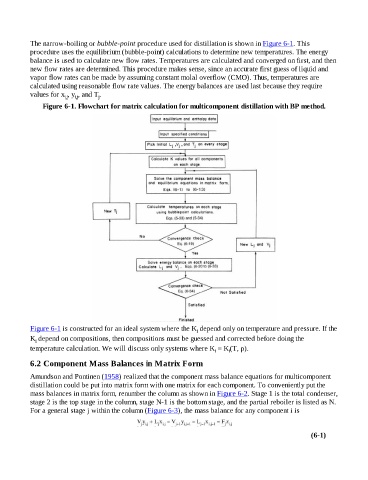
The narrow-boiling or bubble-point procedure used for distillation is shown in Figure 6-1. This
                    procedure uses the equilibrium (bubble-point) calculations to determine new temperatures. The energy
                    balance is used to calculate new flow rates. Temperatures are calculated and converged on first, and then
                    new flow rates are determined. This procedure makes sense, since an accurate first guess of liquid and
                    vapor flow rates can be made by assuming constant molal overflow (CMO). Thus, temperatures are
                    calculated using reasonable flow rate values. The energy balances are used last because they require
                    values for x , y , and T.
                                     i,j
                                 i,j
                                               j
                         Figure 6-1. Flowchart for matrix calculation for multicomponent distillation with BP method.


                    Figure 6-1 is constructed for an ideal system where the K depend only on temperature and pressure. If the
                                                                                     i
                    K depend on compositions, then compositions must be guessed and corrected before doing the
                      i
                    temperature calculation. We will discuss only systems where K = K(T, p).
                                                                                                  i
                                                                                            i
                    6.2 Component Mass Balances in Matrix Form

                    Amundson and Pontinen (1958) realized that the component mass balance equations for multicomponent
                    distillation could be put into matrix form with one matrix for each component. To conveniently put the
                    mass balances in matrix form, renumber the column as shown in Figure 6-2. Stage 1 is the total condenser,
                    stage 2 is the top stage in the column, stage N-1 is the bottom stage, and the partial reboiler is listed as N.
                    For a general stage j within the column (Figure 6-3), the mass balance for any component i is


                                                                                                                                  (6-1)

