


Page 274 - Separation process engineering
P. 274
Chapter 7. Approximate Shortcut Methods for Multicomponent

                    Distillation


                    The previous chapters served as an introduction to multicomponent distillation. Matrix methods are
                    efficient, but they still require a fair amount of time even on a fast computer. In addition, they are
                    simulation methods and require a known number of stages and a specified feed plate location. Fairly
                    rapid approximate methods are required for preliminary economic estimates, for recycle calculations
                    where the distillation is only a small portion of the entire system, for calculations for control systems, and
                    as a first estimate for more detailed simulation calculations.

                    In this chapter we first develop the Fenske equation, which allows calculation of multicomponent
                    separation at total reflux. Then we switch to the Underwood equations, which allow us to calculate the
                    minimum reflux ratio. To predict the approximate number of equilibrium stages we then use the empirical
                    Gilliland correlation that relates the actual number of stages to the number of stages at total reflux, the
                    minimum reflux ratio, and the actual reflux ratio. The feed location can also be approximated from the
                    empirical correlation.

                    7.1 Total Reflux: Fenske Equation


                    Fenske (1932) derived a rigorous solution for binary and multicomponent distillation at total reflux. The
                    derivation assumes that the stages are equilibrium stages.
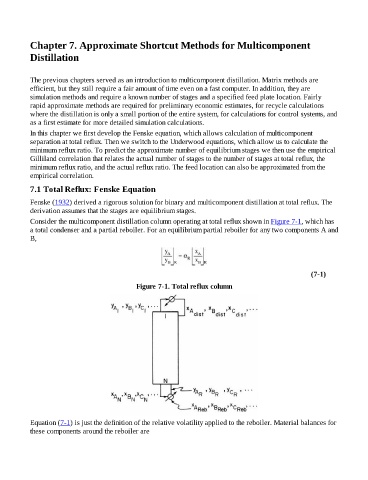
                    Consider the multicomponent distillation column operating at total reflux shown in Figure 7-1, which has
                    a total condenser and a partial reboiler. For an equilibrium partial reboiler for any two components A and
                    B,


                                                                                                                                  (7-1)

                                                             Figure 7-1. Total reflux column


                    Equation (7-1) is just the definition of the relative volatility applied to the reboiler. Material balances for
                    these components around the reboiler are

