


Page 277 - Separation process engineering
P. 277
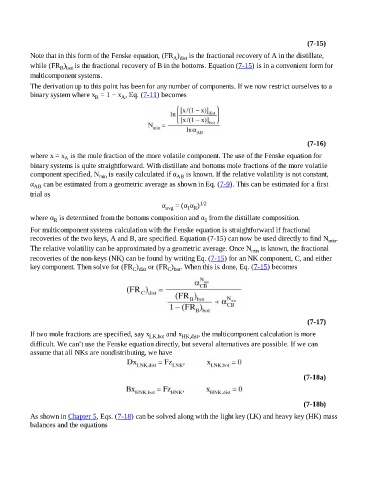
(7-15)

                    Note that in this form of the Fenske equation, (FR )          is the fractional recovery of A in the distillate,
                                                                            A dist
                    while (FR )  is the fractional recovery of B in the bottoms. Equation (7-15) is in a convenient form for
                                B bot
                    multicomponent systems.
                    The derivation up to this point has been for any number of components. If we now restrict ourselves to a
                    binary system where x  = 1 − x , Eq. (7-11) becomes
                                             B
                                                        A


                                                                                                                                (7-16)

                    where x = x  is the mole fraction of the more volatile component. The use of the Fenske equation for
                                 A
                    binary systems is quite straightforward. With distillate and bottoms mole fractions of the more volatile
                    component specified, N     min  is easily calculated if α AB  is known. If the relative volatility is not constant,
                    α AB  can be estimated from a geometric average as shown in Eq. (7-9). This can be estimated for a first

                    trial as
                                                                       α avg  = (α α ) 1/2
                                                                                 1 R
                    where α  is determined from the bottoms composition and α  from the distillate composition.
                             R
                                                                                        1
                    For multicomponent systems calculation with the Fenske equation is straightforward if fractional
                    recoveries of the two keys, A and B, are specified. Equation (7-15) can now be used directly to find N                  .
                                                                                                                                         min
                    The relative volatility can be approximated by a geometric average. Once N            min  is known, the fractional
                    recoveries of the non-keys (NK) can be found by writing Eq. (7-15) for an NK component, C, and either
                    key component. Then solve for (FR )           or (FR ) . When this is done, Eq. (7-15) becomes
                                                                          C bot
                                                            C dist


                                                                                                                                (7-17)

                    If two mole fractions are specified, say x     LK,bot  and x HK,dist , the multicomponent calculation is more
                    difficult. We can’t use the Fenske equation directly, but several alternatives are possible. If we can
                    assume that all NKs are nondistributing, we have


                                                                                                                               (7-18a)


                                                                                                                               (7-18b)

                    As shown in Chapter 5, Eqs. (7-18) can be solved along with the light key (LK) and heavy key (HK) mass
                    balances and the equations

