


Page 282 - Separation process engineering
P. 282
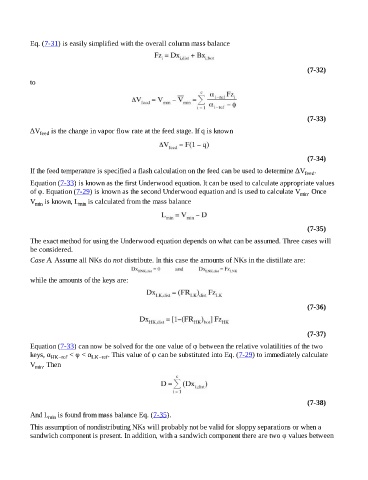
Eq. (7-31) is easily simplified with the overall column mass balance


                                                                                                                                (7-32)

                    to


                                                                                                                                (7-33)

                    ΔV  feed  is the change in vapor flow rate at the feed stage. If q is known


                                                                                                                                (7-34)

                    If the feed temperature is specified a flash calculation on the feed can be used to determine ΔV           feed .

                    Equation (7-33) is known as the first Underwood equation. It can be used to calculate appropriate values
                    of φ. Equation (7-29) is known as the second Underwood equation and is used to calculate V . Once
                                                                                                                             min
                    V  is known, L  is calculated from the mass balance
                      min              min


                                                                                                                                (7-35)

                    The exact method for using the Underwood equation depends on what can be assumed. Three cases will
                    be considered.

                    Case A. Assume all NKs do not distribute. In this case the amounts of NKs in the distillate are:


                    while the amounts of the keys are:


                                                                                                                                (7-36)


                                                                                                                                (7-37)

                    Equation (7-33) can now be solved for the one value of φ between the relative volatilities of the two
                    keys, α HK−ref  < φ < α LK−ref . This value of φ can be substituted into Eq. (7-29) to immediately calculate
                    V . Then
                      min


                                                                                                                                (7-38)
                    And L  is found from mass balance Eq. (7-35).
                           min
                    This assumption of nondistributing NKs will probably not be valid for sloppy separations or when a

                    sandwich component is present. In addition, with a sandwich component there are two φ values between

