


Page 279 - Separation process engineering
P. 279
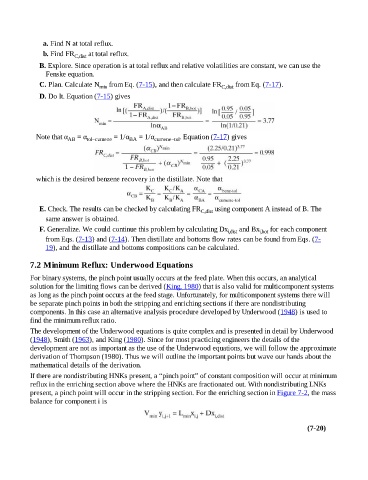
a. Find N at total reflux.
                         b. Find FR        at total reflux.
                                     C,dist
                        B. Explore. Since operation is at total reflux and relative volatilities are constant, we can use the
                          Fenske equation.

                        C. Plan. Calculate N   min  from Eq. (7-15), and then calculate FR     C,dist  from Eq. (7-17).

                        D. Do It. Equation (7-15) gives


                      Note that α      = α           = 1/α     = 1/α          . Equation (7-17) gives
                                   AB     tol−cumene       BA        cumene−tol


                      which is the desired benzene recovery in the distillate. Note that


                        E. Check. The results can be checked by calculating FR         C,dist  using component A instead of B. The

                          same answer is obtained.
                        F. Generalize. We could continue this problem by calculating Dx               and Bx      for each component
                                                                                                 i,dist       i,bot
                          from Eqs. (7-13) and (7-14). Then distillate and bottoms flow rates can be found from Eqs. (7-
                          19), and the distillate and bottoms compositions can be calculated.


                    7.2 Minimum Reflux: Underwood Equations

                    For binary systems, the pinch point usually occurs at the feed plate. When this occurs, an analytical
                    solution for the limiting flows can be derived (King, 1980) that is also valid for multicomponent systems
                    as long as the pinch point occurs at the feed stage. Unfortunately, for multicomponent systems there will
                    be separate pinch points in both the stripping and enriching sections if there are nondistributing
                    components. In this case an alternative analysis procedure developed by Underwood (1948) is used to
                    find the minimum reflux ratio.

                    The development of the Underwood equations is quite complex and is presented in detail by Underwood
                    (1948), Smith (1963), and King (1980). Since for most practicing engineers the details of the
                    development are not as important as the use of the Underwood equations, we will follow the approximate
                    derivation of Thompson (1980). Thus we will outline the important points but wave our hands about the
                    mathematical details of the derivation.

                    If there are nondistributing HNKs present, a “pinch point” of constant composition will occur at minimum
                    reflux in the enriching section above where the HNKs are fractionated out. With nondistributing LNKs
                    present, a pinch point will occur in the stripping section. For the enriching section in Figure 7-2, the mass
                    balance for component i is


                                                                                                                                (7-20)

