


Page 278 - Separation process engineering
P. 278
(7-19)

                    Once all distillate and bottoms compositions or values for Dx         i,dist  and Bx i,bot  have been found, Eqs. (7-11)
                    or (7-12) can be used to find N    min . Use the key components for this calculation. The assumption of

                    nondistribution of the NKs can be checked with Eq. (7-10) or (7-17). If the original assumption is invalid,
                    the calculated value of N   min  obtained for key compositions can be used to calculate the LNK and HNK
                    compositions in distillate and bottoms. Then Eq. (7-11) or (7-12) is used again.

                    If NKs do distribute, a reasonable first guess for the distribution is required. This guess can be obtained
                    by assuming that the distribution of NKs is the same at total reflux as it is at minimum reflux. The
                    distribution at minimum reflux can be obtained from the Underwood equation and is covered later.

                    Accurate use of the Fenske equation obviously requires an accurate value for the relative volatility. Smith
                    (1963) covers in detail a method of calculating α by estimating temperatures and calculating the geometric
                    average relative volatility. Winn (1958) developed a modification of the Fenske equation that allows the
                    relative volatility to vary. Wankat and Hubert (1979) modified both the Fenske and Winn equations for
                    nonequilibrium stages by including a vaporization efficiency.


                      Example 7-1. Fenske equation
                      A distillation column with a partial reboiler and a total condenser is being used to separate a mixture
                      of benzene, toluene, and cumene. The feed is 40 mol% benzene, 30 mol% toluene, and 30 mol%

                      cumene and is input as a saturated vapor. We desire 95% recovery of the toluene in the distillate and
                      95% recovery of the cumene in the bottoms. The reflux is returned as a saturated liquid, and constant
                      molal overflow (CMO) can be assumed. Pressure is 1 atm.
                      Equilibrium can be represented as constant relative volatilities. Choosing toluene as the reference

                      component, α   benz−tol  = 2.25 and α cumene−tol  = 0.21. Find the number of equilibrium stages required at
                      total reflux and the recovery fraction of benzene in the distillate.

                      Solution

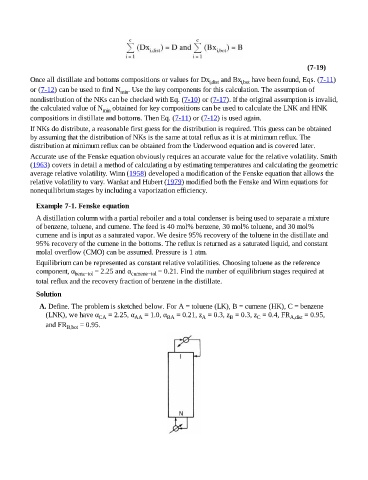
                        A. Define. The problem is sketched below. For A = toluene (LK), B = cumene (HK), C = benzene
                          (LNK), we have α         = 2.25, α     = 1.0, α    = 0.21, z  = 0.3, z  = 0.3, z  = 0.4, FR          = 0.95,
                                               CA            AA          BA            A          B          C            A,dist
                          and FR  B,bot  = 0.95.

