


Page 284 - Separation process engineering
P. 284
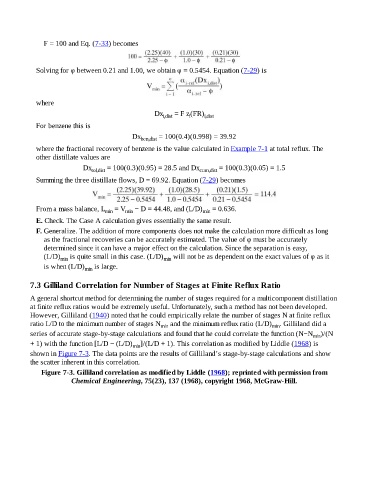
F = 100 and Eq. (7-33) becomes


                      Solving for φ between 0.21 and 1.00, we obtain φ = 0.5454. Equation (7-29) is


                      where

                                                                     Dx i,dist  = F z(FR) i,dist
                                                                                  i
                      For benzene this is

                                                            Dx ben,dist  = 100(0.4)(0.998) = 39.92

                      where the fractional recovery of benzene is the value calculated in Example 7-1 at total reflux. The
                      other distillate values are
                                         Dx tol,dist  = 100(0.3)(0.95) = 28.5 and Dx  cum,dist  = 100(0.3)(0.05) = 1.5

                      Summing the three distillate flows, D = 69.92. Equation (7-29) becomes


                      From a mass balance, L  = V  − D = 44.48, and (L/D)              min  = 0.636.
                                                 min
                                                         min
                      E. Check. The Case A calculation gives essentially the same result.

                      F. Generalize. The addition of more components does not make the calculation more difficult as long
                         as the fractional recoveries can be accurately estimated. The value of φ must be accurately
                         determined since it can have a major effect on the calculation. Since the separation is easy,
                         (L/D)  min  is quite small in this case. (L/D) min  will not be as dependent on the exact values of φ as it
                         is when (L/D)   min  is large.


                    7.3 Gilliland Correlation for Number of Stages at Finite Reflux Ratio

                    A general shortcut method for determining the number of stages required for a multicomponent distillation
                    at finite reflux ratios would be extremely useful. Unfortunately, such a method has not been developed.
                    However, Gilliland (1940) noted that he could empirically relate the number of stages N at finite reflux
                    ratio L/D to the minimum number of stages N        min  and the minimum reflux ratio (L/D)    min . Gilliland did a

                    series of accurate stage-by-stage calculations and found that he could correlate the function (N−N            min )/(N
                    + 1) with the function [L/D − (L/D)     min ]/(L/D + 1). This correlation as modified by Liddle (1968) is

                    shown in Figure 7-3. The data points are the results of Gilliland’s stage-by-stage calculations and show
                    the scatter inherent in this correlation.
                        Figure 7-3. Gilliland correlation as modified by Liddle (1968); reprinted with permission from
                                    Chemical Engineering, 75(23), 137 (1968), copyright 1968, McGraw-Hill.

