


Page 289 - Separation process engineering
P. 289
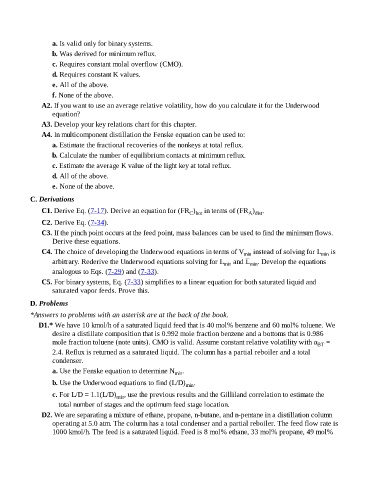
a. Is valid only for binary systems.
                             b. Was derived for minimum reflux.

                             c. Requires constant molal overflow (CMO).

                             d. Requires constant K values.
                             e. All of the above.
                             f. None of the above.

                        A2. If you want to use an average relative volatility, how do you calculate it for the Underwood
                             equation?

                        A3. Develop your key relations chart for this chapter.
                        A4. In multicomponent distillation the Fenske equation can be used to:

                             a. Estimate the fractional recoveries of the nonkeys at total reflux.
                             b. Calculate the number of equilibrium contacts at minimum reflux.

                             c. Estimate the average K value of the light key at total reflux.
                             d. All of the above.

                             e. None of the above.

                    C. Derivations

                        C1. Derive Eq. (7-17). Derive an equation for (FR )  in terms of (FR )                 .
                                                                                  C bot                  A dist
                        C2. Derive Eq. (7-34).
                        C3. If the pinch point occurs at the feed point, mass balances can be used to find the minimum flows.
                             Derive these equations.

                        C4. The choice of developing the Underwood equations in terms of V  instead of solving for L  is
                                                                                                                                      min
                                                                                                       min
                             arbitrary. Rederive the Underwood equations solving for L  and               min . Develop the equations
                                                                                                min
                             analogous to Eqs. (7-29) and (7-33).
                        C5. For binary systems, Eq. (7-33) simplifies to a linear equation for both saturated liquid and
                             saturated vapor feeds. Prove this.

                    D. Problems

                    *Answers to problems with an asterisk are at the back of the book.

                       D1.* We have 10 kmol/h of a saturated liquid feed that is 40 mol% benzene and 60 mol% toluene. We
                             desire a distillate composition that is 0.992 mole fraction benzene and a bottoms that is 0.986
                             mole fraction toluene (note units). CMO is valid. Assume constant relative volatility with α  =
                                                                                                                                    BT
                             2.4. Reflux is returned as a saturated liquid. The column has a partial reboiler and a total
                             condenser.

                             a. Use the Fenske equation to determine N      min .

                             b. Use the Underwood equations to find (L/D)        min .

                             c. For L/D = 1.1(L/D)    min , use the previous results and the Gilliland correlation to estimate the
                               total number of stages and the optimum feed stage location.
                        D2. We are separating a mixture of ethane, propane, n-butane, and n-pentane in a distillation column
                             operating at 5.0 atm. The column has a total condenser and a partial reboiler. The feed flow rate is

                             1000 kmol/h. The feed is a saturated liquid. Feed is 8 mol% ethane, 33 mol% propane, 49 mol%

