


Page 293 - Separation process engineering
P. 293
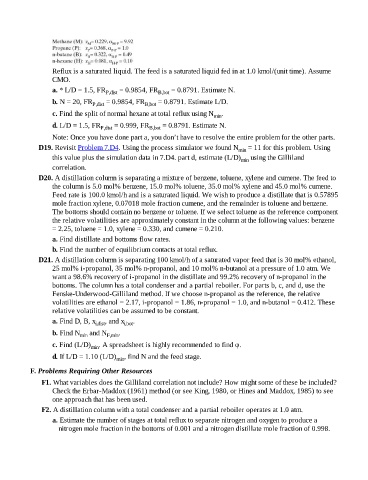
Reflux is a saturated liquid. The feed is a saturated liquid fed in at 1.0 kmol/(unit time). Assume
                             CMO.
                             a. * L/D = 1.5, FR   P,dist  = 0.9854, FR B,bot  = 0.8791. Estimate N.

                             b. N = 20, FR  P,dist  = 0.9854, FR B,bot  = 0.8791. Estimate L/D.

                             c. Find the split of normal hexane at total reflux using N     min .

                             d. L/D = 1.5, FR   P,dist  = 0.999, FR B,bot  = 0.8791. Estimate N.

                             Note: Once you have done part a, you don’t have to resolve the entire problem for the other parts.
                       D19. Revisit Problem 7.D4. Using the process simulator we found N             min  = 11 for this problem. Using

                             this value plus the simulation data in 7.D4. part d, estimate (L/D)      min  using the Gilliland
                             correlation.

                       D20. A distillation column is separating a mixture of benzene, toluene, xylene and cumene. The feed to
                             the column is 5.0 mol% benzene, 15.0 mol% toluene, 35.0 mol% xylene and 45.0 mol% cumene.
                             Feed rate is 100.0 kmol/h and is a saturated liquid. We wish to produce a distillate that is 0.57895
                             mole fraction xylene, 0.07018 mole fraction cumene, and the remainder is toluene and benzene.
                             The bottoms should contain no benzene or toluene. If we select toluene as the reference component
                             the relative volatilities are approximately constant in the column at the following values: benzene
                             = 2.25, toluene = 1.0, xylene = 0.330, and cumene = 0.210.

                             a. Find distillate and bottoms flow rates.
                             b. Find the number of equilibrium contacts at total reflux.

                       D21. A distillation column is separating 100 kmol/h of a saturated vapor feed that is 30 mol% ethanol,
                             25 mol% i-propanol, 35 mol% n-propanol, and 10 mol% n-butanol at a pressure of 1.0 atm. We
                             want a 98.6% recovery of i-propanol in the distillate and 99.2% recovery of n-propanol in the
                             bottoms. The column has a total condenser and a partial reboiler. For parts b, c, and d, use the
                             Fenske-Underwood-Gilliland method. If we choose n-propanol as the reference, the relative
                             volatilities are ethanol = 2.17, i-propanol = 1.86, n-propanol = 1.0, and n-butanol = 0.412. These
                             relative volatilities can be assumed to be constant.

                             a. Find D, B, x i,dist , and x i,bot .
                             b. Find N min  and N F,min .

                             c. Find (L/D)  min . A spreadsheet is highly recommended to find φ.

                             d. If L/D = 1.10 (L/D)   min , find N and the feed stage.


                    F. Problems Requiring Other Resources
                        F1. What variables does the Gilliland correlation not include? How might some of these be included?

                             Check the Erbar-Maddox (1961) method (or see King, 1980, or Hines and Maddox, 1985) to see
                             one approach that has been used.
                        F2. A distillation column with a total condenser and a partial reboiler operates at 1.0 atm.

                             a. Estimate the number of stages at total reflux to separate nitrogen and oxygen to produce a
                               nitrogen mole fraction in the bottoms of 0.001 and a nitrogen distillate mole fraction of 0.998.

