


Page 295 - Separation process engineering
P. 295
Chapter 8. Introduction to Complex Distillation Methods


                    We have looked at binary and multicomponent mixtures in both simple and fairly complex columns.
                    However, the chemicals separated have usually had fairly simple equilibrium behavior. In this chapter
                    you will be introduced to a variety of more complex distillation systems used for the separation of less
                    ideal mixtures.

                    Simple distillation columns are not able to completely separate mixtures when azeotropes occur, and the
                    columns are very expensive when the relative volatility is close to 1. Distillation columns can be coupled
                    with other separation methods to break the azeotrope. This is discussed in the first section. Extractive
                    distillation, azeotropic distillation, and two-pressure distillation are methods for modifying the
                    equilibrium to separate these complex mixtures. These three methods are described in Sections 8.2 to 8.7
                    of this chapter. In Section 8.8 we discuss the use of a distillation column as a chemical reactor, to
                    simultaneously react and separate a mixture.

                    8.1 Breaking Azeotropes with Other Separators


                    Azeotropic systems normally limit the separation that can be achieved. For an azeotropic system such as
                    ethanol and water (shown in Figures 2-2 and 4-13), it isn’t possible to get past the azeotropic
                    concentration of 0.8943 mole frac ethanol with ordinary distillation. Some other separation method is
                    required to break the azeotrope. The other method could employ adsorption (Chapter 18), membranes
                    (Chapter 17), extraction (Chapter 13), and so forth. It could also involve adding a third component to the
                    distillation to give the azeotropic and extractive distillation systems discussed later in this chapter.
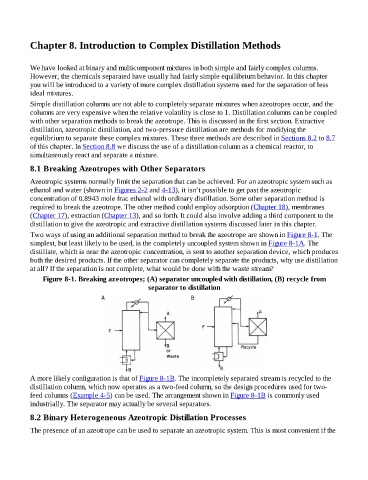
                    Two ways of using an additional separation method to break the azeotrope are shown in Figure 8-1. The

                    simplest, but least likely to be used, is the completely uncoupled system shown in Figure 8-1A. The
                    distillate, which is near the azeotropic concentration, is sent to another separation device, which produces
                    both the desired products. If the other separator can completely separate the products, why use distillation
                    at all? If the separation is not complete, what would be done with the waste stream?
                         Figure 8-1. Breaking azeotropes; (A) separator uncoupled with distillation, (B) recycle from
                                                                  separator to distillation


                    A more likely configuration is that of Figure 8-1B. The incompletely separated stream is recycled to the
                    distillation column, which now operates as a two-feed column, so the design procedures used for two-
                    feed columns (Example 4-5) can be used. The arrangement shown in Figure 8-1B is commonly used
                    industrially. The separator may actually be several separators.

                    8.2 Binary Heterogeneous Azeotropic Distillation Processes

                    The presence of an azeotrope can be used to separate an azeotropic system. This is most convenient if the

