


Page 299 - Separation process engineering
P. 299
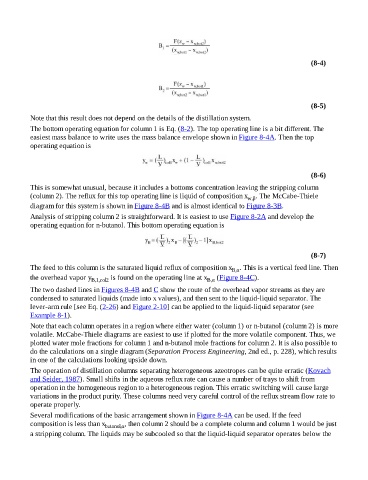
(8-4)


                                                                                                                                  (8-5)

                    Note that this result does not depend on the details of the distillation system.

                    The bottom operating equation for column 1 is Eq. (8-2). The top operating line is a bit different. The
                    easiest mass balance to write uses the mass balance envelope shown in Figure 8-4A. Then the top
                    operating equation is


                                                                                                                                  (8-6)

                    This is somewhat unusual, because it includes a bottoms concentration leaving the stripping column
                    (column 2). The reflux for this top operating line is liquid of composition x        w,β . The McCabe-Thiele

                    diagram for this system is shown in Figure 8-4B and is almost identical to Figure 8-3B.
                    Analysis of stripping column 2 is straightforward. It is easiest to use Figure 8-2A and develop the
                    operating equation for n-butanol. This bottom operating equation is


                                                                                                                                  (8-7)
                    The feed to this column is the saturated liquid reflux of composition x        B,α . This is a vertical feed line. Then

                    the overhead vapor y    B,1,col2  is found on the operating line at x B,α  (Figure 8-4C).

                    The two dashed lines in Figures 8-4B and C show the route of the overhead vapor streams as they are
                    condensed to saturated liquids (made into x values), and then sent to the liquid-liquid separator. The
                    lever-arm rule [see Eq. (2-26) and Figure 2-10] can be applied to the liquid-liquid separator (see
                    Example 8-1).

                    Note that each column operates in a region where either water (column 1) or n-butanol (column 2) is more
                    volatile. McCabe-Thiele diagrams are easiest to use if plotted for the more volatile component. Thus, we
                    plotted water mole fractions for column 1 and n-butanol mole fractions for column 2. It is also possible to
                    do the calculations on a single diagram (Separation Process Engineering, 2nd ed., p. 228), which results
                    in one of the calculations looking upside down.

                    The operation of distillation columns separating heterogeneous azeotropes can be quite erratic (Kovach
                    and Seider, 1987). Small shifts in the aqueous reflux rate can cause a number of trays to shift from
                    operation in the homogeneous region to a heterogeneous region. This erratic switching will cause large
                    variations in the product purity. These columns need very careful control of the reflux stream flow rate to
                    operate properly.
                    Several modifications of the basic arrangement shown in Figure 8-4A can be used. If the feed

                    composition is less than x   butanol,α , then column 2 should be a complete column and column 1 would be just
                    a stripping column. The liquids may be subcooled so that the liquid-liquid separator operates below the

