


Page 302 - Separation process engineering
P. 302
= 0.015. The solubility data give the compositions of the streams leaving the settler. Use Eq.
                         benz
                         (8-13) for equilibrium. At the boiling point of benzene (80.1°C), VP          benz  = 760 mm Hg and VP  =
                                                                                                                                    w
                         356.6 mm Hg (Perry and Green, 1997). Operation will be at a different temperature, but the ratio of
                         vapor pressures will be approximately constant.
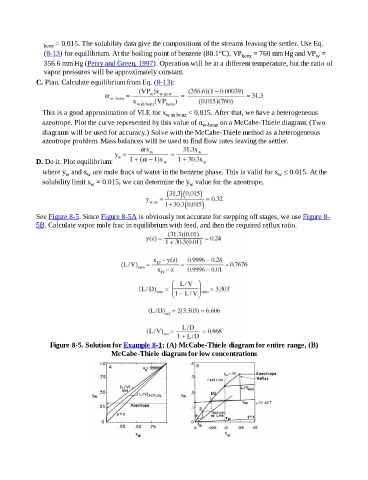
                      C. Plan. Calculate equilibrium from Eq. (8-13):


                         This is a good approximation of VLE for x       w in benz  < 0.015. After that, we have a heterogeneous
                         azeotrope. Plot the curve represented by this value of α      w-benz  on a McCabe-Thiele diagram. (Two

                         diagrams will be used for accuracy.) Solve with the McCabe-Thiele method as a heterogeneous
                         azeotrope problem. Mass balances will be used to find flow rates leaving the settler.


                      D. Do it. Plot equilibrium:
                         where y  and x  are mole fracs of water in the benzene phase. This is valid for x  ≤ 0.015. At the
                                  w
                                          w
                                                                                                                     w
                         solubility limit x  = 0.015, we can determine the y  value for the azeotrope,
                                            w
                                                                                  w


                      See Figure 8-5. Since Figure 8-5A is obviously not accurate for stepping off stages, we use Figure 8-
                      5B. Calculate vapor mole frac in equilibrium with feed, and then the required reflux ratio.


                            Figure 8-5. Solution for Example 8-1; (A) McCabe-Thiele diagram for entire range, (B)
                                                    McCabe-Thiele diagram for low concentrations

