


Page 303 - Separation process engineering
P. 303
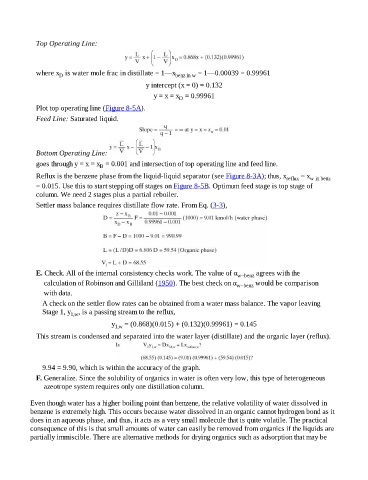
Top Operating Line:


                      where x  is water mole frac in distillate = 1—x        benz in w  = 1—0.00039 = 0.99961
                               D
                                                                 y intercept (x = 0) = 0.132

                                                                    y = x = x  = 0.99961
                                                                              D
                      Plot top operating line (Figure 8-5A).
                      Feed Line: Saturated liquid.


                      Bottom Operating Line:
                      goes through y = x = x  = 0.001 and intersection of top operating line and feed line.
                                               B
                      Reflux is the benzene phase from the liquid-liquid separator (see Figure 8-3A); thus, x           reflux  = x w in benz

                      = 0.015. Use this to start stepping off stages on Figure 8-5B. Optimum feed stage is top stage of
                      column. We need 2 stages plus a partial reboiler.
                      Settler mass balance requires distillate flow rate. From Eq. (3-3),


                      E. Check. All of the internal consistency checks work. The value of α          w–benz  agrees with the
                         calculation of Robinson and Gilliland (1950). The best check on α           w–benz  would be comparison

                         with data.
                         A check on the settler flow rates can be obtained from a water mass balance. The vapor leaving
                         Stage 1, y 1,w , is a passing stream to the reflux,

                                                    y    = (0.868)(0.015) + (0.132)(0.99961) = 0.145
                                                     1,w
                      This stream is condensed and separated into the water layer (distillate) and the organic layer (reflux).


                         9.94 = 9.90, which is within the accuracy of the graph.

                      F. Generalize. Since the solubility of organics in water is often very low, this type of heterogeneous
                         azeotrope system requires only one distillation column.


                    Even though water has a higher boiling point than benzene, the relative volatility of water dissolved in
                    benzene is extremely high. This occurs because water dissolved in an organic cannot hydrogen bond as it
                    does in an aqueous phase, and thus, it acts as a very small molecule that is quite volatile. The practical
                    consequence of this is that small amounts of water can easily be removed from organics if the liquids are
                    partially immiscible. There are alternative methods for drying organics such as adsorption that may be

