


Page 304 - Separation process engineering
P. 304
cheaper than distillation in many cases.

                    8.3 Steam Distillation

                    In steam distillation, water (as steam) is intentionally added to the distilling organic mixture to reduce the
                    required temperature and to keep suspended any solids that may be present. Steam distillation may be

                    operated with one or two liquid phases in the column. In both cases the overhead vapor will condense
                    into two phases. Thus, the system can be considered a type of azeotropic distillation where the added
                    solvent is water and the separation is between volatiles and nonvolatiles. This is a pseudo-binary
                    distillation with water and the volatile organic forming a heterogeneous azeotrope. Steam distillation is
                    commonly used for purification of essential oils in the perfume industry, for distillation of organics
                    obtained from coal, for hydrocarbon distillations, and for removing solvents from solids in waste
                    disposal (Ellerbe, 1997; Ludwig, 1997; Woodland, 1978).

                    For steam distillation with a liquid water phase present, both the water and organic layers exert their own
                    vapor pressures. At 1 atm pressure the temperature must be less than 100 °C even though the organic
                    material by itself might boil at several hundred degrees. Thus, one advantage of steam distillation is
                    lower operating temperatures. With two liquid phases present and in equilibrium, their compositions will
                    be fixed by their mutual solubilities. Since each phase exerts its own vapor pressure, the vapor
                    composition will be constant regardless of the average liquid concentration. A heterogeneous azeotrope is
                    formed. As the amount of water or organic is increased, the phase concentrations do not change; only the
                    amount of each liquid phase will change. Since an azeotrope has been reached, no additional separation is
                    obtained by adding more stages. Thus, only a reboiler is required. This type of steam distillation is often
                    done as a batch operation (see Chapter 9).

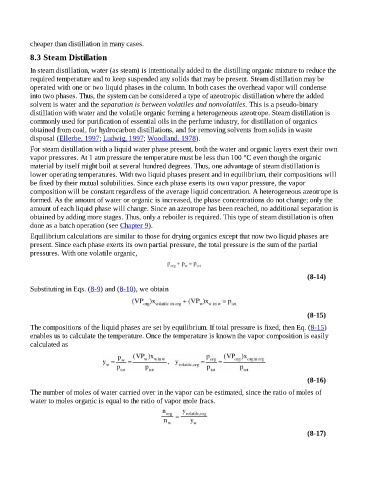
                    Equilibrium calculations are similar to those for drying organics except that now two liquid phases are
                    present. Since each phase exerts its own partial pressure, the total pressure is the sum of the partial
                    pressures. With one volatile organic,


                                                                                                                                (8-14)

                    Substituting in Eqs. (8-9) and (8-10), we obtain


                                                                                                                                (8-15)

                    The compositions of the liquid phases are set by equilibrium. If total pressure is fixed, then Eq. (8-15)
                    enables us to calculate the temperature. Once the temperature is known the vapor composition is easily
                    calculated as


                                                                                                                                (8-16)

                    The number of moles of water carried over in the vapor can be estimated, since the ratio of moles of
                    water to moles organic is equal to the ratio of vapor mole fracs.


                                                                                                                                (8-17)

