


Page 306 - Separation process engineering
P. 306
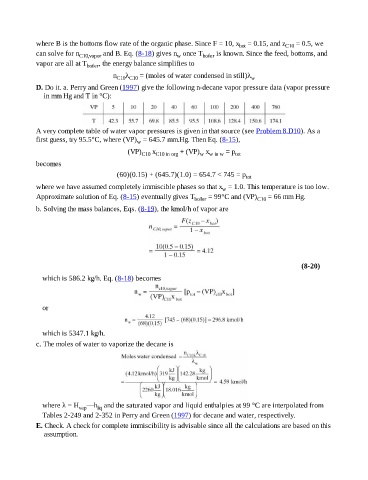
where B is the bottoms flow rate of the organic phase. Since F = 10, x  = 0.15, and z             C10  = 0.5, we
                                                                                                      bot
                      can solve for n  C10,vapor  and B. Eq. (8-18) gives n  once T    boiler  is known. Since the feed, bottoms, and
                                                                             w
                      vapor are all at T  boiler , the energy balance simplifies to

                                                         λ
                                                    n C10 C10  = (moles of water condensed in still)λ     w
                      D. Do it. a. Perry and Green (1997) give the following n-decane vapor pressure data (vapor pressure
                         in mm Hg and T in °C):


                      A very complete table of water vapor pressures is given in that source (see Problem 8.D10). As a
                      first guess, try 95.5°C, where (VP)  = 645.7 mm.Hg. Then Eq. (8-15),
                                                              w
                                                          (VP)  C10 C10 in org  + (VP)  x        = p tot
                                                                    x
                                                                                      w w in w
                      becomes

                                                      (60)(0.15) + (645.7)(1.0) = 654.7 < 745 = p       tot

                      where we have assumed completely immiscible phases so that x  = 1.0. This temperature is too low.
                                                                                               w
                      Approximate solution of Eq. (8-15) eventually gives T         boiler  = 99°C and (VP)  C10  = 66 mm Hg.

                      b. Solving the mass balances, Eqs. (8-19), the kmol/h of vapor are


                                                                                                                              (8-20)

                         which is 586.2 kg/h. Eq. (8-18) becomes


                         or


                         which is 5347.1 kg/h.
                      c. The moles of water to vaporize the decane is


                         where λ = H   vap —h  and the saturated vapor and liquid enthalpies at 99 °C are interpolated from
                                              liq
                         Tables 2-249 and 2-352 in Perry and Green (1997) for decane and water, respectively.

                      E. Check. A check for complete immiscibility is advisable since all the calculations are based on this
                         assumption.

