


Page 308 - Separation process engineering
P. 308
water (Drew, 1997). At 1 atm the azeotrope contains 35% water, while at 100 psia the azeotrope is 50%
                    water. If a feed containing more than 35% water is fed to the first column, the bottoms will be pure water.
                    The distillate from this atmospheric column will be the 35% azeotrope. When this azeotrope is sent to the
                    high-pressure column, an azeotrope containing 50% water comes off as the distillate; this distillate is
                    recycled to column 1. Since the feed to column 2 (the 35% azeotrope) contains less water than this
                    distillate, the bottoms from column 2 is pure MEK. Note that the water is less volatile in column 1 and the
                    MEK is less volatile in column 2.

                    Mass balances for the system shown in Figure 8-6 are of interest. The external mass balances are
                    identical to Eqs. (8-3a) and (8-3b). Thus, the bottoms flow rates are given by Eqs. (8-4) and (8-5).
                    Although the processes shown in Figures 8-4A and 8-6 are very different, they look the same to the
                    external mass balances. Differences in the processes become evident when balances are written for
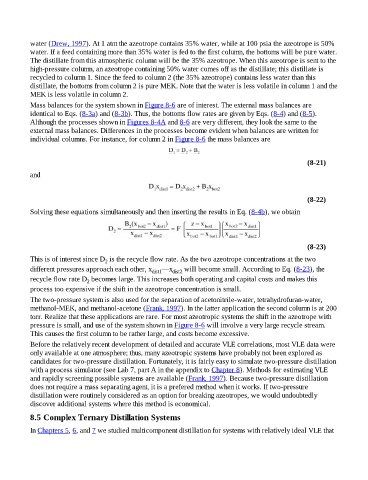
                    individual columns. For instance, for column 2 in Figure 8-6 the mass balances are


                                                                                                                                (8-21)

                    and


                                                                                                                                (8-22)

                    Solving these equations simultaneously and then inserting the results in Eq. (8-4b), we obtain


                                                                                                                                (8-23)
                    This is of interest since D  is the recycle flow rate. As the two azeotrope concentrations at the two
                                                 2
                    different pressures approach each other, x      dist1 —x dist2  will become small. According to Eq. (8-23), the
                    recycle flow rate D  becomes large. This increases both operating and capital costs and makes this
                                          2
                    process too expensive if the shift in the azeotrope concentration is small.
                    The two-pressure system is also used for the separation of acetonitrile-water, tetrahydrofuran-water,
                    methanol-MEK, and methanol-acetone (Frank, 1997). In the latter application the second column is at 200
                    torr. Realize that these applications are rare. For most azeotropic systems the shift in the azeotrope with

                    pressure is small, and use of the system shown in Figure 8-6 will involve a very large recycle stream.
                    This causes the first column to be rather large, and costs become excessive.
                    Before the relatively recent development of detailed and accurate VLE correlations, most VLE data were
                    only available at one atmosphere; thus, many azeotropic systems have probably not been explored as
                    candidates for two-pressure distillation. Fortunately, it is fairly easy to simulate two-pressure distillation

                    with a process simulator (see Lab 7, part A in the appendix to Chapter 8). Methods for estimating VLE
                    and rapidly screening possible systems are available (Frank, 1997). Because two-pressure distillation
                    does not require a mass separating agent, it is a prefered method when it works. If two-pressure
                    distillation were routinely considered as an option for breaking azeotropes, we would undoubtedly
                    discover additional systems where this method is economical.

                    8.5 Complex Ternary Distillation Systems

                    In Chapters 5, 6, and 7 we studied multicomponent distillation for systems with relatively ideal VLE that

