


Page 305 - Separation process engineering
P. 305
Substituting in Eq. (8-16), we obtain


                                                                                                                                (8-18)

                    If several organics are present, y  and p  are the sums of the respective values for all the organics. The
                                                                   org
                                                         org
                    total moles of steam required is n  plus the amount condensed to heat and vaporize the organic (see
                                                          w
                    Example 8-2).

                      Example 8-2. Steam distillation

                      A cutting oil that has approximately the properties of n-decane (C  H ) is to be recovered from
                                                                                                 10  22
                      nonvolatile oils and solids in a steady-state single-stage steam distillation. Operation will be with
                      liquid water present. The feed is 50 mol% n-decane. A bottoms that is 15 mol% n-decane in the
                      organic phase is desired. Feed rate is 10 kmol/h. Feed enters at the temperature of the boiler.
                      Pressure is atmospheric pressure, which in your plant is approximately 745 mm Hg. Find:
                      a. The temperature of the still

                      b. The moles of water carried over in the vapor

                      c. The moles of water in the bottoms

                      Solution

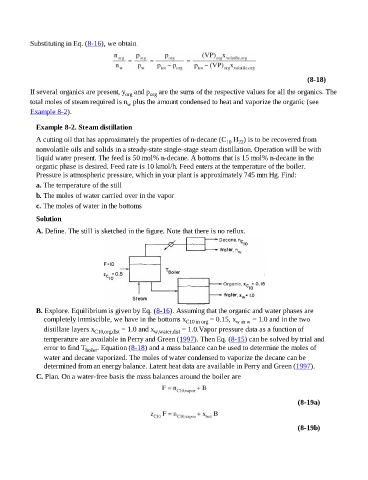
                      A. Define. The still is sketched in the figure. Note that there is no reflux.


                      B. Explore. Equilibrium is given by Eq. (8-16). Assuming that the organic and water phases are
                         completely immiscible, we have in the bottoms x         C10 in org  = 0.15, x w in w  = 1.0 and in the two

                         distillate layers x C10,org,dist  = 1.0 and x w,water,dist  = 1.0.Vapor pressure data as a function of
                         temperature are available in Perry and Green (1997). Then Eq. (8-15) can be solved by trial and
                         error to find T  boiler . Equation (8-18) and a mass balance can be used to determine the moles of
                         water and decane vaporized. The moles of water condensed to vaporize the decane can be

                         determined from an energy balance. Latent heat data are available in Perry and Green (1997).
                      C. Plan. On a water-free basis the mass balances around the boiler are


                                                                                                                             (8-19a)


                                                                                                                             (8-19b)

