


Page 307 - Separation process engineering
P. 307
F. Generalize. Obviously, the decane is boiled over at a temperature well below its boiling point, but
                         a large amount of water is required. Most of this water is carried over in the vapor. On a weight
                         basis, the kilograms of total water required per kilogram decane vaporized is 9.26. Less water will
                         be used if the boiler is at a higher temperature and there is no liquid water in the still. Less water is
                         also used for higher values of x    org,bot  (see Problem 8.D10).


                    Additional separation can be obtained by operating without a liquid water phase in the column. Reducing
                    the number of phases increases the degrees of freedom by one. Operation must be at a temperature higher
                    than that predicted by Eq. (8-15), or a liquid water layer will form in the column. Thus, the column must
                    be heated with a conventional reboiler and/or the sensible heat available in superheated steam. The latent
                    heat available in the steam cannot be used, because it would produce a layer of liquid water. Operation
                    without liquid water in the column reduces the energy requirements but makes the system more complex.

                    8.4 Two-Pressure Distillation Processes

                    Pressure affects vapor-liquid equilibrium (VLE), and in systems that form azeotropes it will affect the

                    composition of the azeotrope. For example, Table 2-1 shows that the ethanol-water system has an
                    azeotrope at 0.8943 mole frac ethanol at 1 atm pressure. If the pressure is reduced, the azeotropic
                    concentration increases (Seader, 1984). At pressures below 70 mm Hg, the azeotrope disappears entirely,
                    and the distillation can be done in a simple column. Unfortunately, use of this disappearance of the
                    azeotrope for the separation of ethanol and water is not economical because the column requires a large
                    number of stages and has a large diameter (Black, 1980). However, the principle of finding a pressure
                    where the azeotrope disappears may be useful in other distillations. The effect of pressure on the
                    azeotropic composition and temperature can be estimated using the VLE correlations in process
                    simulators (Waslkiewski, 2005).

                    Even though the azeotrope may not disappear, in general, pressure affects the azeotropic composition. If
                    the shift in composition is large enough, a two-column process using two different pressures can be used
                    to completely separate the binary mixture. Doherty et al. (2008) recommend a minimum mole fraction
                    change of at least 5% (e.g., from 55% to 60%) with a 10% change being preferable. A schematic of the
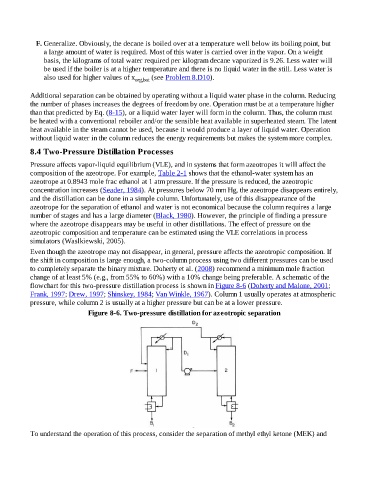
                    flowchart for this two-pressure distillation process is shown in Figure 8-6 (Doherty and Malone, 2001;
                    Frank, 1997; Drew, 1997; Shinskey, 1984; Van Winkle, 1967). Column 1 usually operates at atmospheric
                    pressure, while column 2 is usually at a higher pressure but can be at a lower pressure.

                                           Figure 8-6. Two-pressure distillation for azeotropic separation


                    To understand the operation of this process, consider the separation of methyl ethyl ketone (MEK) and

