


Page 312 - Separation process engineering
P. 312
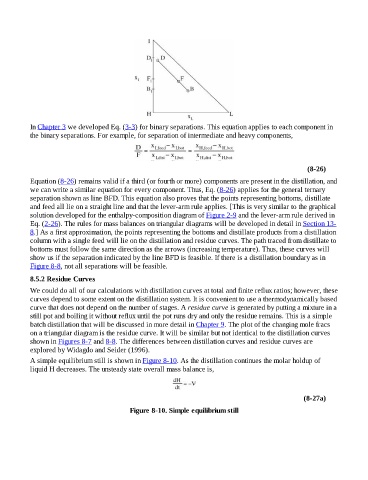
In Chapter 3 we developed Eq. (3-3) for binary separations. This equation applies to each component in
                    the binary separations. For example, for separation of intermediate and heavy components,


                                                                                                                                (8-26)


                    Equation (8-26) remains valid if a third (or fourth or more) components are present in the distillation, and
                    we can write a similar equation for every component. Thus, Eq. (8-26) applies for the general ternary
                    separation shown as line BFD. This equation also proves that the points representing bottoms, distillate
                    and feed all lie on a straight line and that the lever-arm rule applies. [This is very similar to the graphical
                    solution developed for the enthalpy-composition diagram of Figure 2-9 and the lever-arm rule derived in
                    Eq. (2-26). The rules for mass balances on triangular diagrams will be developed in detail in Section 13-
                    8.] As a first approximation, the points representing the bottoms and distillate products from a distillation
                    column with a single feed will lie on the distillation and residue curves. The path traced from distillate to
                    bottoms must follow the same direction as the arrows (increasing temperature). Thus, these curves will
                    show us if the separation indicated by the line BFD is feasible. If there is a distillation boundary as in
                    Figure 8-8, not all separations will be feasible.

                    8.5.2 Residue Curves

                    We could do all of our calculations with distillation curves at total and finite reflux ratios; however, these
                    curves depend to some extent on the distillation system. It is convenient to use a thermodynamically based
                    curve that does not depend on the number of stages. A residue curve is generated by putting a mixture in a
                    still pot and boiling it without reflux until the pot runs dry and only the residue remains. This is a simple
                    batch distillation that will be discussed in more detail in Chapter 9. The plot of the changing mole fracs
                    on a triangular diagram is the residue curve. It will be similar but not identical to the distillation curves
                    shown in Figures 8-7 and 8-8. The differences between distillation curves and residue curves are

                    explored by Widagdo and Seider (1996).
                    A simple equilibrium still is shown in Figure 8-10. As the distillation continues the molar holdup of
                    liquid H decreases. The unsteady state overall mass balance is,


                                                                                                                               (8-27a)

                                                           Figure 8-10. Simple equilibrium still

