


Page 313 - Separation process engineering
P. 313
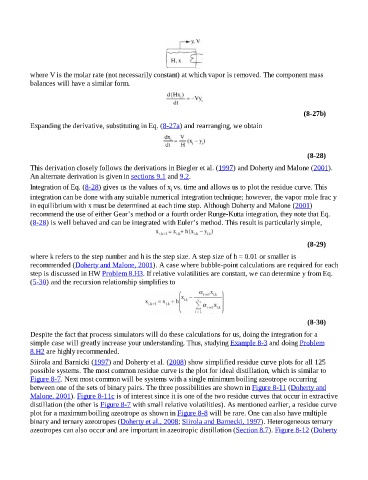
where V is the molar rate (not necessarily constant) at which vapor is removed. The component mass
                    balances will have a similar form.


                                                                                                                               (8-27b)

                    Expanding the derivative, substituting in Eq. (8-27a) and rearranging, we obtain


                                                                                                                                (8-28)

                    This derivation closely follows the derivations in Biegler et al. (1997) and Doherty and Malone (2001).
                    An alternate derivation is given in sections 9.1 and 9.2.

                    Integration of Eq. (8-28) gives us the values of x vs. time and allows us to plot the residue curve. This
                                                                           i
                    integration can be done with any suitable numerical integration technique; however, the vapor mole frac y
                    in equilibrium with x must be determined at each time step. Although Doherty and Malone (2001)

                    recommend the use of either Gear’s method or a fourth order Runge-Kutta integration, they note that Eq.
                    (8-28) is well behaved and can be integrated with Euler’s method. This result is particularly simple,


                                                                                                                                (8-29)

                    where k refers to the step number and h is the step size. A step size of h = 0.01 or smaller is
                    recommended (Doherty and Malone, 2001). A case where bubble-point calculations are required for each
                    step is discussed in HW Problem 8.H3. If relative volatilities are constant, we can determine y from Eq.
                    (5-30) and the recursion relationship simplifies to


                                                                                                                                (8-30)

                    Despite the fact that process simulators will do these calculations for us, doing the integration for a
                    simple case will greatly increase your understanding. Thus, studying Example 8-3 and doing Problem
                    8.H2 are highly recommended.

                    Siirola and Barnicki (1997) and Doherty et al. (2008) show simplified residue curve plots for all 125
                    possible systems. The most common residue curve is the plot for ideal distillation, which is similar to
                    Figure 8-7. Next most common will be systems with a single minimum boiling azeotrope occurring
                    between one of the sets of binary pairs. The three possibilities are shown in Figure 8-11 (Doherty and
                    Malone, 2001). Figure 8-11c is of interest since it is one of the two residue curves that occur in extractive
                    distillation (the other is Figure 8-7 with small relative volatilities). As mentioned earlier, a residue curve
                    plot for a maximum boiling azeotrope as shown in Figure 8-8 will be rare. One can also have multiple
                    binary and ternary azeotropes (Doherty et al., 2008; Siirola and Barnecki, 1997). Heterogeneous ternary
                    azeotropes can also occur and are important in azeotropic distillation (Section 8.7). Figure 8-12 (Doherty

