


Page 285 - Separation process engineering
P. 285
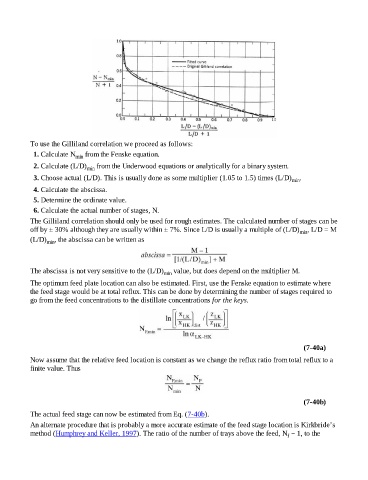
To use the Gilliland correlation we proceed as follows:

                     1. Calculate N   min  from the Fenske equation.

                     2. Calculate (L/D)   min  from the Underwood equations or analytically for a binary system.

                     3. Choose actual (L/D). This is usually done as some multiplier (1.05 to 1.5) times (L/D)            min .

                     4. Calculate the abscissa.
                     5. Determine the ordinate value.

                     6. Calculate the actual number of stages, N.
                    The Gilliland correlation should only be used for rough estimates. The calculated number of stages can be
                    off by ± 30% although they are usually within ± 7%. Since L/D is usually a multiple of (L/D)             min , L/D = M

                    (L/D) min , the abscissa can be written as


                    The abscissa is not very sensitive to the (L/D)     min  value, but does depend on the multiplier M.

                    The optimum feed plate location can also be estimated. First, use the Fenske equation to estimate where
                    the feed stage would be at total reflux. This can be done by determining the number of stages required to
                    go from the feed concentrations to the distillate concentrations for the keys.


                                                                                                                               (7-40a)

                    Now assume that the relative feed location is constant as we change the reflux ratio from total reflux to a
                    finite value. Thus


                                                                                                                               (7-40b)

                    The actual feed stage can now be estimated from Eq. (7-40b).

                    An alternate procedure that is probably a more accurate estimate of the feed stage location is Kirkbride’s
                    method (Humphrey and Keller, 1997). The ratio of the number of trays above the feed, N  − 1, to the
                                                                                                                         f

