


Page 286 - Separation process engineering
P. 286
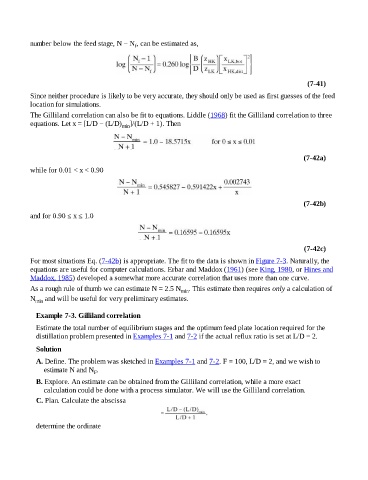
number below the feed stage, N − N , can be estimated as,
                                                             f


                                                                                                                                (7-41)

                    Since neither procedure is likely to be very accurate, they should only be used as first guesses of the feed
                    location for simulations.
                    The Gilliland correlation can also be fit to equations. Liddle (1968) fit the Gilliland correlation to three

                    equations. Let x = [L/D − (L/D)     min ]/(L/D + 1). Then


                                                                                                                               (7-42a)

                    while for 0.01 < x < 0.90


                                                                                                                               (7-42b)

                    and for 0.90 ≤ x ≤ 1.0


                                                                                                                               (7-42c)

                    For most situations Eq. (7-42b) is appropriate. The fit to the data is shown in Figure 7-3. Naturally, the
                    equations are useful for computer calculations. Erbar and Maddox (1961) (see King, 1980, or Hines and
                    Maddox, 1985) developed a somewhat more accurate correlation that uses more than one curve.

                    As a rough rule of thumb we can estimate N = 2.5 N         min . This estimate then requires only a calculation of
                    N min  and will be useful for very preliminary estimates.


                      Example 7-3. Gilliland correlation

                      Estimate the total number of equilibrium stages and the optimum feed plate location required for the
                      distillation problem presented in Examples 7-1 and 7-2 if the actual reflux ratio is set at L/D = 2.

                      Solution

                      A. Define. The problem was sketched in Examples 7-1 and 7-2. F = 100, L/D = 2, and we wish to

                         estimate N and N .
                                             F
                      B. Explore. An estimate can be obtained from the Gilliland correlation, while a more exact
                         calculation could be done with a process simulator. We will use the Gilliland correlation.

                      C. Plan. Calculate the abscissa


                      determine the ordinate

