


Page 131 - Social Marketing for Public Health Global Trends and Success Stories
P. 131
57977_CH04_final.qxd:Cheng  11/5/09  4:38 PM  Page 104


                104    CHAPTER 4  ■ Love, Sex, and HIV/AIDS


                                                        the JPEG campaign and Programs H and M in
                                                        the public education sector in Brazil and India”
                                                        (Christine Ricardo, Instituto Promundo, per-
                                                        sonal communication, August 20, 2008).
                                                            Although the alliance members are pleased
                                                        that results of gender-equality programs indi-
                                                        cate that cultural change and subsequent HIV
                                                        prevention are possible, they agree there is
                                                        much to be done to continue the momentum
                                                         of this global movement.
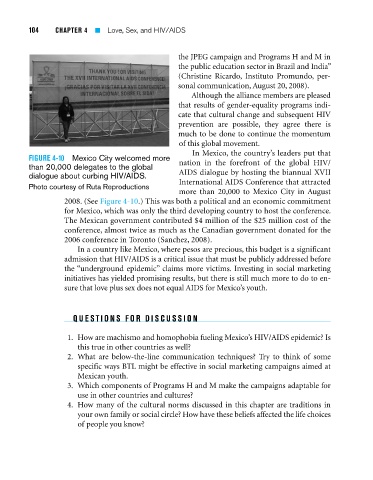
                                                            In Mexico, the country’s leaders put that
                FIGURE 4-10 Mexico City welcomed more    nation in the forefront of the global HIV/
                than 20,000 delegates to the global
                dialogue about curbing HIV/AIDS.         AIDS dialogue by hosting the biannual XVII
                                                         International AIDS Conference that attracted
                Photo courtesy of Ruta Reproductions
                                                         more than 20,000 to Mexico City in August
                          2008. (See Figure 4-10.) This was both a political and an economic commitment
                          for Mexico, which was only the third developing country to host the conference.
                          The Mexican government contributed $4 million of the $25 million cost of the
                          conference, almost twice as much as the Canadian government donated for the
                          2006 conference in Toronto (Sanchez, 2008).
                             In a country like Mexico, where pesos are precious, this budget is a significant
                          admission that HIV/AIDS is a critical issue that must be publicly addressed before
                          the “underground epidemic” claims more victims. Investing in social marketing
                          initiatives has yielded promising results, but there is still much more to do to en-
                          sure that love plus sex does not equal AIDS for Mexico’s youth.


                            QU ESTIONS F OR DISCUS S ION

                          1. How are machismo and homophobia fueling Mexico’s HIV/AIDS epidemic? Is
                             this true in other countries as well?
                          2. What are below-the-line communication techniques? Try to think of some
                             specific ways BTL might be effective in social marketing campaigns aimed at
                             Mexican youth.
                          3. Which components of Programs H and M make the campaigns adaptable for
                             use in other countries and cultures?
                          4. How many of the cultural norms discussed in this chapter are traditions in
                             your own family or social circle? How have these beliefs affected the life choices
                             of people you know?

