


Page 130 - Social Marketing for Public Health Global Trends and Success Stories
P. 130
57977_CH04_final.qxd:Cheng  11/5/09  4:38 PM  Page 103


                                                                                      Summary     103


                      S UMM A RY

                    What is the measure of success for a social marketing initiative? If demonstrated
                    behavioral change by the downstream audiences and policy changes and approba-
                    tion by upstream decision makers are valid indicators, Programs H and M are ex-
                    tremely successful.
                       For the young men and women targeted by the interventions, the conclusion is
                    that addressing unequal gender norms, especially machismo attitudes, is a vital part
                    of HIV-prevention strategies. These changes can conceivably extend into future
                    generations, leading to a culture with stronger, healthier personal relationships.
                        “Young men don’t learn behaviors in isolation,” said Dr. Gary Barker, former
                    executive director of Promundo and one of Program H’s creators. The kind of in-
                    dividual reflection Program H and M generates is a first step in changing what is
                    expected behavior for men and women (Hutchinson et al., 2004, p.7).
                       Program H’s results are receiving international notice. In their 2006 annual re-
                    ports, the UN Children’s Fund (UNICEF) and the World Bank lauded Program H
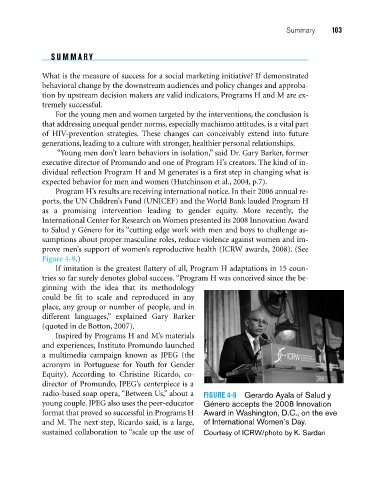
                    as a promising intervention leading to gender equity. More recently, the
                    International Center for Research on Women presented its 2008 Innovation Award
                    to Salud y Género for its “cutting edge work with men and boys to challenge as-
                    sumptions about proper masculine roles, reduce violence against women and im-
                    prove men’s support of women’s reproductive health (ICRW awards, 2008). (See
                    Figure 4-9.)
                       If imitation is the greatest flattery of all, Program H adaptations in 15 coun-
                    tries so far surely denotes global success. “Program H was conceived since the be-
                    ginning with the idea that its methodology
                    could be fit to scale and reproduced in any
                    place, any group or number of people, and in
                    different languages,” explained Gary Barker
                    (quoted in de Botton, 2007).
                       Inspired by Programs H and M’s materials
                    and experiences, Instituto Promundo launched
                    a multimedia campaign known as JPEG (the
                    acronym in Portuguese for Youth for Gender
                    Equity).  According to Christine Ricardo, co-
                    director of Promundo, JPEG’s centerpiece is a
                    radio-based soap opera, “Between Us,” about a  FIGURE 4-9 Gerardo Ayala of Salud y
                    young couple. JPEG also uses the peer-educator  Género accepts the 2008 Innovation
                    format that proved so successful in Programs H  Award in Washington, D.C., on the eve
                    and M. The next step, Ricardo said, is a large,  of International Women’s Day.
                    sustained collaboration to “scale up the use of  Courtesy of ICRW/photo by K. Sardari

