


Page 125 - Social Marketing for Public Health Global Trends and Success Stories
P. 125
57977_CH04_final.qxd:Cheng  11/5/09  4:38 PM  Page 98


                98     CHAPTER 4  ■ Love, Sex, and HIV/AIDS


                           than young women to seek health services, making it difficult to reach them
                           with information and other services, so Program H takes information to them
                           in the communities where they live. Entertainment venues such as bars, com-
                           munity dances, and parties proved to be effective ways to reach the target audi-
                           ence. In addition, the Mexican Ministry of Health adopted Program H, and
                           10,000 copies were printed with the government’s seal, lending official credibil-
                           ity to the initiative.
                              According to Gerardo Ayala, of Salud y Género, healthcare providers have used
                           Program H’s methodology to reach more than 10,000 young people in six states—
                           Chiapas, Baja California Sur, Sonora, Distrito Federal, Veracruz, and Querétaro.
                           “The way in which we spread and implemented Program H in Mexico is very di-
                           verse and tends to be massive,” Ayala elaborated (quoted in de Botton, 2007).

                           Promotion Strategies

                           Unlike many developing countries, where social marketing is used to combat
                           HIV/AIDS, Mexico has a high average literacy rate: almost 93% for men and
                           90% for women (U.S. Department of State, 2008).
                                                     As might be expected, young people are more likely
                                                 to use the Internet, although of Mexico’s 110 million
                                                 people, only about 20% have access to the  Web
                                                 (Internet  World Stats, 2007). The Latin culture is
                                                 family/relationship oriented, so personal communica-
                                                 tion is often more effective—and more credible—than
                                                 mediated communication channels. Nevertheless, so-
                                                 cial marketers are increasingly incorporating new me-
                                                 dia tools to stretch their budgets while expanding their
                                                 reach to young computer-savvy audiences. As part of
                                                 that outreach, comprehensive information about
                                                 Programs H and M is available online and the cartoon
                                                 videos can be viewed on YouTube.
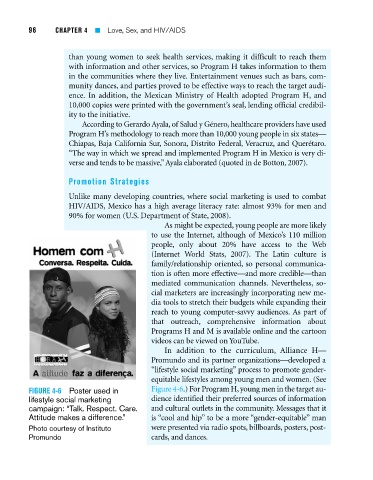
                                                     In addition to the curriculum,  Alliance H—
                                                 Promundo and its partner organizations—developed a
                                                 “lifestyle social marketing” process to promote gender-
                                                 equitable lifestyles among young men and women. (See
                FIGURE 4-6 Poster used in        Figure 4-6.) For Program H, young men in the target au-
                lifestyle social marketing       dience identified their preferred sources of information
                campaign: “Talk. Respect. Care.  and cultural outlets in the community. Messages that it
                Attitude makes a difference.”    is “cool and hip” to be a more “gender-equitable” man
                Photo courtesy of Instituto      were presented via radio spots, billboards, posters, post-
                Promundo                         cards, and dances.

