


Page 121 - Social Marketing for Public Health Global Trends and Success Stories
P. 121
57977_CH04_final.qxd:Cheng  11/5/09  4:38 PM  Page 94


                94     CHAPTER 4  ■ Love, Sex, and HIV/AIDS


                           methodological procedures or tested techniques, validated and with a proven
                           social impact created with the aim of solving a social problem” (Instituto
                           Promundo, 2008c).
                              The Program H curriculum was developed in 1999 by four Latin American
                           NGOs and coordinated by Instituto Promundo, including Salud y Género
                           (Queretaro and Xalapa, Mexico), Ecos (São Paulo, Brazil), and Instituto PAPAI
                           (Recife, Brazil). The curriculum provides a framework to examine gender issues,
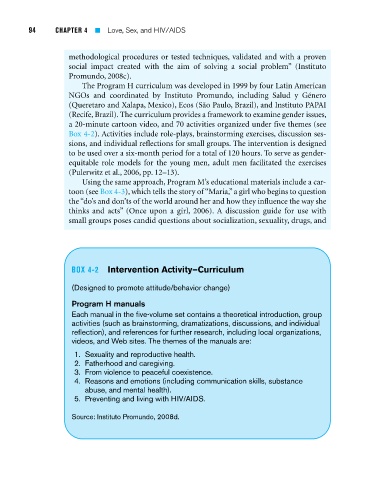
                           a 20-minute cartoon video, and 70 activities organized under five themes (see
                           Box 4-2). Activities include role-plays, brainstorming exercises, discussion ses-
                           sions, and individual reflections for small groups. The intervention is designed
                           to be used over a six-month period for a total of 120 hours. To serve as gender-
                           equitable role models for the young men, adult men facilitated the exercises
                           (Pulerwitz et al., 2006, pp. 12–13).
                              Using the same approach, Program M’s educational materials include a car-
                           toon (see Box 4-3), which tells the story of “Maria,” a girl who begins to question
                           the “do’s and don’ts of the world around her and how they influence the way she
                           thinks and acts” (Once  upon  a  girl, 2006). A discussion guide for use with
                           small groups poses candid questions about socialization, sexuality, drugs, and


                            BOX 4-2  Intervention Activity—Curriculum
                            (Designed to promote attitude/behavior change)

                            Program H manuals
                            Each manual in the five-volume set contains a theoretical introduction, group
                            activities (such as brainstorming, dramatizations, discussions, and individual
                            reflection), and references for further research, including local organizations,
                            videos, and Web sites. The themes of the manuals are:
                            1. Sexuality and reproductive health.
                            2. Fatherhood and caregiving.
                            3. From violence to peaceful coexistence.
                            4. Reasons and emotions (including communication skills, substance
                               abuse, and mental health).
                            5. Preventing and living with HIV/AIDS.

                            Source: Instituto Promundo, 2008d.

