


Page 118 - Social Marketing for Public Health Global Trends and Success Stories
P. 118
57977_CH04_final.qxd:Cheng  11/5/09  4:38 PM  Page 91


                                                    Barriers, Opportunities (Benefits), and Competition  91


                       B A R R IER S, O P P O R TUNITIE S ( B ENEF I T S) ,
                       A N D C O M P E TITI O N

                     Making such revolutionary and deep-seated societal changes is an ambitious proj-
                     ect with a host of obstacles, ranging from political to religious to economic. With
                     Mexico’s political climate in transition, both barriers and opportunities for change
                     exist. The business-friendly PAN has responded to pressure from diverse interests
                     to tackle discrimination that contributes to the spread of HIV/AIDS. Then-
                     president Vicente Fox signed a constitutional amendment in 2001 that outlawed
                     discrimination, including bias based on sexuality. Since 2003, federal agencies in
                     Mexico have been required to fund tolerance campaigns (Campbell, 2005).
                        But early socialization that establishes inequitable gender roles as the norm
                     may encourage risky behaviors among both young men and women. Instituto Pro-
                     mundo’s research indicates gender inequity in relationships—when men have
                     greater power than women—can also lead to sexual coercion and physical vio-
                     lence, circumstances in which HIV-protective behaviors are impossible to initi-
                     ate and maintain (Pulerwitz, Barker, Segundo, & Nascimento, 2006, p. 4).
                        For both audiences, the tenets
                     of machismo—if practiced by
                     young men and accepted by
                     young women—dictate lifelong
                     patterns that distort personal re-
                     lationships and endanger the
                     health of future generations. (See
                     Figure 4-2.)
                        The benefits of reversing
                     these traditional beliefs are self-
                     evident, but timing is critical
                     because attitudes formed in ado-
                     lescence often crystallize into life-
                     long behavior patterns. Marcos
                     Nascimento, now Promundo co-
                     director, noted that international
                     research with teens indicates
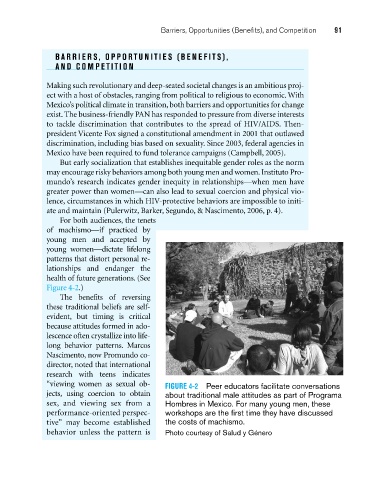
                     “viewing women as sexual ob-    FIGURE 4-2 Peer educators facilitate conversations
                     jects, using coercion to obtain  about traditional male attitudes as part of Programa
                     sex, and viewing sex from a     Hombres in Mexico. For many young men, these
                     performance-oriented perspec-   workshops are the first time they have discussed
                     tive” may become established    the costs of machismo.
                     behavior unless the pattern is  Photo courtesy of Salud y Género

