


Page 119 - Social Marketing for Public Health Global Trends and Success Stories
P. 119
57977_CH04_final.qxd:Cheng  11/5/09  4:38 PM  Page 92


                92     CHAPTER 4  ■ Love, Sex, and HIV/AIDS


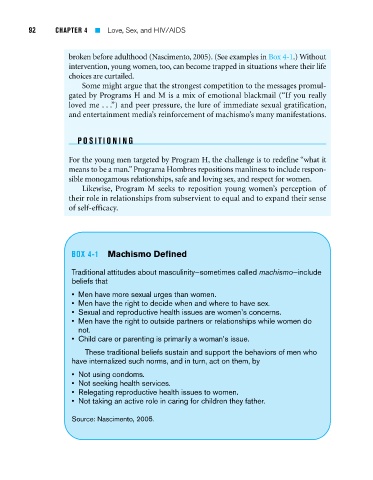
                           broken before adulthood (Nascimento, 2005). (See examples in Box 4-1.) Without
                           intervention, young women, too, can become trapped in situations where their life
                           choices are curtailed.
                              Some might argue that the strongest competition to the messages promul-
                           gated by Programs H and M is a mix of emotional blackmail (“If you really
                           loved me . . .”) and peer pressure, the lure of immediate sexual gratification,
                           and entertainment media’s reinforcement of machismo’s many manifestations.


                             P O S I TI O NIN G

                           For the young men targeted by Program H, the challenge is to redefine “what it
                           means to be a man.” Programa Hombres repositions manliness to include respon-
                           sible monogamous relationships, safe and loving sex, and respect for women.
                              Likewise, Program M seeks to reposition young women’s perception of
                           their role in relationships from subservient to equal and to expand their sense
                           of self-efficacy.


                            BOX 4-1  Machismo Defined

                            Traditional attitudes about masculinity—sometimes called machismo—include
                            beliefs that

                            • Men have more sexual urges than women.
                            • Men have the right to decide when and where to have sex.
                            • Sexual and reproductive health issues are women’s concerns.
                            • Men have the right to outside partners or relationships while women do
                             not.
                            • Child care or parenting is primarily a woman’s issue.
                               These traditional beliefs sustain and support the behaviors of men who
                            have internalized such norms, and in turn, act on them, by
                            • Not using condoms.
                            • Not seeking health services.
                            • Relegating reproductive health issues to women.
                            • Not taking an active role in caring for children they father.

                            Source: Nascimento, 2005.

