


Page 246 - Social Marketing for Public Health Global Trends and Success Stories
P. 246
57977_CH09_final.qxd:Cheng  11/5/09  4:42 PM  Page 219


                                                                                      Summary     219


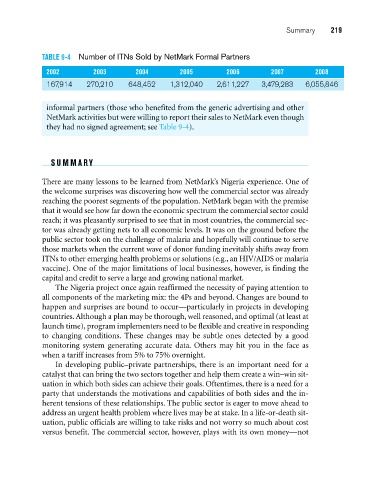
                    TABLE 9-4  Number of ITNs Sold by NetMark Formal Partners
                     2002        2003        2004        2005        2006         2007       2008
                     167,914    270,210    648,452    1,312,040    2,611,227   3,479,283   6,055,846


                     informal partners (those who benefited from the generic advertising and other
                     NetMark activities but were willing to report their sales to NetMark even though
                     they had no signed agreement; see Table 9-4).


                      S UMM A RY


                    There are many lessons to be learned from NetMark’s Nigeria experience. One of
                    the welcome surprises was discovering how well the commercial sector was already
                    reaching the poorest segments of the population. NetMark began with the premise
                    that it would see how far down the economic spectrum the commercial sector could
                    reach; it was pleasantly surprised to see that in most countries, the commercial sec-
                    tor was already getting nets to all economic levels. It was on the ground before the
                    public sector took on the challenge of malaria and hopefully will continue to serve
                    those markets when the current wave of donor funding inevitably shifts away from
                    ITNs to other emerging health problems or solutions (e.g., an HIV/AIDS or malaria
                    vaccine). One of the major limitations of local businesses, however, is finding the
                    capital and credit to serve a large and growing national market.
                       The Nigeria project once again reaffirmed the necessity of paying attention to
                    all components of the marketing mix: the 4Ps and beyond. Changes are bound to
                    happen and surprises are bound to occur—particularly in projects in developing
                    countries. Although a plan may be thorough, well reasoned, and optimal (at least at
                    launch time), program implementers need to be flexible and creative in responding
                    to changing conditions. These changes may be subtle ones detected by a good
                    monitoring system generating accurate data. Others may hit you in the face as
                    when a tariff increases from 5% to 75% overnight.
                       In developing public–private partnerships, there is an important need for a
                    catalyst that can bring the two sectors together and help them create a win–win sit-
                    uation in which both sides can achieve their goals. Oftentimes, there is a need for a
                    party that understands the motivations and capabilities of both sides and the in-
                    herent tensions of these relationships. The public sector is eager to move ahead to
                    address an urgent health problem where lives may be at stake. In a life-or-death sit-
                    uation, public officials are willing to take risks and not worry so much about cost
                    versus benefit. The commercial sector, however, plays with its own money—not

