


Page 254 - Soil and water contamination, 2nd edition
P. 254
Chemical transformation                                               241


                      0

                      5

                     10

                     15
                     Depth
                     20

                     25

                     30

                     6642  6642  6642  35
                      0         50       100       150      200       250       300      350
                                                  Horizontal distance
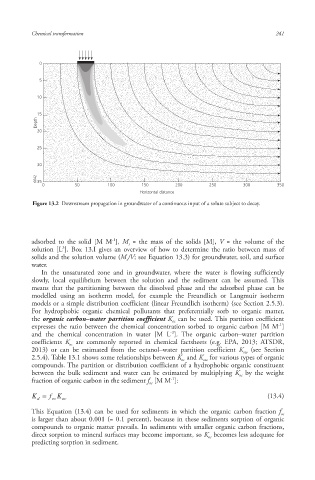
                    Figure 13.2  Downstream propagation in groundwater of a continuous input of a solute subject to decay.


                                          -1
                   adsorbed to the solid [M M ],  M   = the mass of the solids [M],  V = the volume of the
                                               s
                            3
                   solution [L ]. Box 13.I gives an overview of how to determine the ratio between mass of
                   solids and the solution volume (M /V; see Equation 13.3) for groundwater, soil, and surface
                                              s
                   water.
                      In the  unsaturated zone and in groundwater, where the water is flowing sufficiently
                   slowly, local equilibrium  between the solution and the sediment  can be assumed.  This
                   means that the partitioning  between the dissolved phase  and the adsorbed phase  can be


                   modelled using an isotherm  model, for example the Freundlich  or Langmuir isotherm
                   models or a simple distribution coefficient  (linear Freundlich isotherm ) (see Section 2.5.3).

                   For hydrophobic organic chemical pollutants that preferentially sorb to organic matter ,

                   the organic carbon–water partition coefficient K   can be used. This partition coefficient
                                                           oc
                                                                                          -1
                   expresses the ratio between the chemical concentration sorbed to organic carbon  [M M ]
                                                           -3
                   and the chemical concentration in water [M L ].  The organic carbon–water partition
                   coefficient  s  K  are commonly reported in chemical factsheets (e.g. EPA, 2013; ATSDR,
                              oc

                   2013) or can be estimated from the octanol–water partition coefficient  K  (see Section

                                                                                ow
                   2.5.4). Table 13.1 shows some relationships between K  and K  for various types of organic
                                                              oc    ow
                   compounds. The partition or distribution coefficient  of a hydrophobic organic constituent
                   between the bulk sediment and water can be estimated by multiplying  K  by the weight
                                                                               oc
                                                           -1
                   fraction of organic carbon in the sediment f  [M M ]:
                                                     oc
                   K    f oc K oc                                                      (13.4)
                     d
                   This Equation (13.4) can be used for sediments in which the organic carbon  fraction  f
                                                                                          oc
                   is larger than about 0.001 (= 0.1 percent), because in these sediments sorption  of organic
                   compounds to organic matter  prevails. In sediments with smaller organic carbon fractions,
                   direct sorption to mineral surfaces may become important, so K  becomes less adequate for
                                                                      oc
                   predicting sorption in sediment.
                                                                                            10/1/2013   6:45:10 PM
        Soil and Water.indd   253
        Soil and Water.indd   253                                                           10/1/2013   6:45:10 PM

