


Page 256 - Soil and water contamination, 2nd edition
P. 256
Chemical transformation                                               243

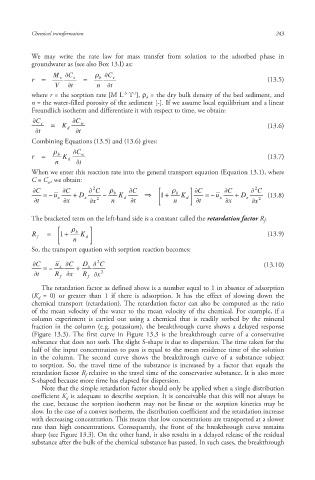
                   We may write the rate law for mass transfer from solution to the adsorbed phase  in

                   groundwater as (see also Box 13.I) as:
                         M    C          C
                   r       s   s       b  s                                            (13.5)
                          V    t      n   t
                                                -1
                                             -3
                   where r = the sorption  rate [M L  T ], ρ  = the dry bulk density  of the bed sediment , and
                                                    b
                   n = the water-filled porosity  of the sediment [-]. If we assume local equilibrium and a linear

                   Freundlich isotherm  and differentiate it with respect to time, we obtain:
                     C          C
                      s     K    w                                                     (13.6)
                     t       d   t
                   Combining Equations (13.5) and (13.6) gives:
                                C w
                           b
                   r        K d                                                        (13.7)
                          n      t
                   When we enter this reaction rate into the general transport equation  (Equation 13.1), where
                   C = C , we obtain:
                        w
                     C       C       2 C   b    C           b      C       C       2 C
                          u x     D x       K d         1     K d       u x     D x    (13.8)
                     t       x       x 2  n     t           n      t       x       x 2

                   The bracketed term on the left-hand side is a constant called the retardation  factor  R :
                                                                                      f
                   R  f     1     b  K d                                               (13.9)
                               n
                   So, the transport equation  with sorption  reaction becomes:

                     C    u x  C  D x  2 C                                            (13.10)

                     t    R   x   R   x 2
                           f       f
                      The retardation  factor  as defined above is a number equal to 1 in absence of adsorption
                   (K  = 0) or greater than 1 if there is adsorption. It has the effect of slowing down the
                     d
                   chemical transport (retardation). The retardation factor can also be computed as the ratio
                   of the mean velocity of the water to the mean velocity of the chemical. For example, if a
                   column experiment is carried out using a chemical that is readily sorbed by the mineral
                   fraction in the column (e.g. potassium ), the breakthrough curve  shows a delayed response
                   (Figure 13.3). The first curve in Figure 13.3 is the breakthrough curve of a conservative
                   substance that does not sorb. The slight S-shape is due to dispersion . The time taken for the
                   half of the input concentration to pass is equal to the mean residence time  of the solution
                   in the column.  The second curve shows the breakthrough curve of a substance subject
                   to sorption . So, the travel time  of the substance is increased by a factor that equals the
                   retardation factor R  relative to the travel time of the conservative substance. It is also more
                                   f
                   S-shaped because more time has elapsed for dispersion.
                      Note that the simple retardation  factor  should only be applied when a single distribution
                   coefficient  K  is adequate to describe sorption . It is conceivable that this will not always be
                             d
                   the case, because the sorption isotherm  may not be linear or the sorption kinetics  may be
                   slow. In the case of a convex isotherm, the distribution coefficient and the retardation increase
                   with decreasing concentration. This means that low concentrations are transported at a slower
                   rate than high concentrations. Consequently, the front of the breakthrough curve  remains
                   sharp (see Figure 13.3). On the other hand, it also results in a delayed release of the residual
                   substance after the bulk of the chemical substance has passed. In such cases, the breakthrough


                                                                                            10/1/2013   6:45:10 PM
        Soil and Water.indd   255                                                           10/1/2013   6:45:10 PM
        Soil and Water.indd   255

