


Page 106 - Standard Handbook Of Petroleum & Natural Gas Engineering
P. 106
Applied  Statistics   95
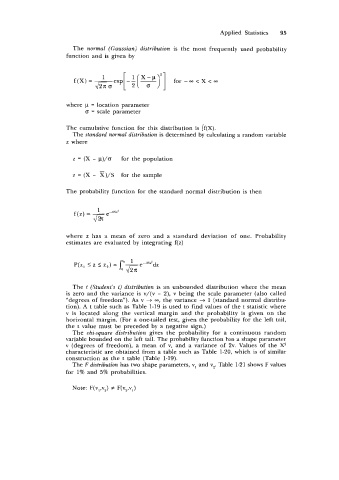
                       The  normal  (Gaussian)  distribution  is  the  most  frequently  used  probability
                     function  and  is given by


                     where  y  = location  parameter
                           o = scale parameter


                     The cumulative function  for  this  distribution  is ff(X).
                       The standard  normal distribution is determined by  calculating a random variable
                     z  where


                       z  = (X - y)/o   for the  population
                       z  = (X -  x)/S   for  the  sample


                     The  probability  function  for the  standard  normal  distribution  is  then


                     where  z  has  a  mean  of  zero  and  a  standard  deviation  of  one.  Probability
                     estimates  are evaluated  by  integrating  f(z)


                       The t  (Student’s t) distribution  is  an  unbounded  distribution  where  the  mean
                     is  zero  and  the  variance  is v/(v  - 2),  v  being  the  scale parameter  (also called
                     “degrees of  freedom”). As  v -+  00,  the variance + 1 (standard  normal  distribu-
                     tion). A  t table  such as Table  1-19 is used  to find values of  the t  statistic where
                     v  is  located  along  the  vertical  margin  and  the  probability  is  given  on  the
                     horizontal  margin.  (For a one-tailed  test,  given  the probability  for  the left  tail,
                     the  t  value must  be  preceded  by  a negative  sign.)
                       The  chi-square  distribution  gives  the  probability  for  a  continuous  random
                     variable bounded on the left tail. The probability function has a shape parameter
                     v  (degrees of  freedom), a  mean  of  v,  and  a  variance  of  2v.  Values  of  the  X2
                     characteristic are obtained  from a  table  such  as Table  1-20, which is of  similar
                     construction  as  the  t  table  (Table 1-19).
                       The F distribution has two shape parameters, v,  and v2. Table 1-21 shows F values
                     for  1% and  5% probabilities.

                       Note:  F(v,,v,) f F(v,,v,)

