


Page 328 - Statistics for Dummies
P. 328
312
                                         Part V: Statistical Studies and the Hunt for a Meaningful Relationship
                                                    Here’s an example to help you better understand dependence: A recent
                                                    press release put out by The Ohio State University Medical Center caught my
                                                    attention. The headline said that aspirin can prevent polyps in colon-cancer
                                                    patients. Having had a close relative who succumbed to this disease, I was
                                                    heartened at the prospect that researchers are making progress in this area
                                                    and decided to look into it.
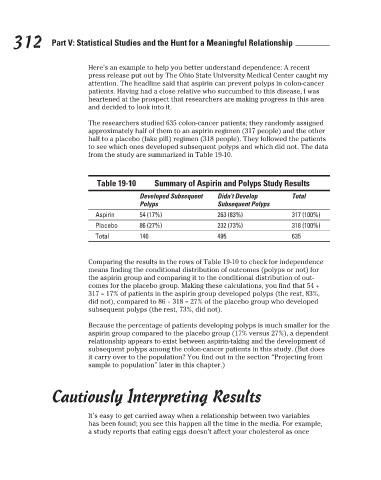
                                                    The researchers studied 635 colon-cancer patients; they randomly assigned
                                                    approximately half of them to an aspirin regimen (317 people) and the other
                                                    half to a placebo (fake pill) regimen (318 people). They followed the patients
                                                    to see which ones developed subsequent polyps and which did not. The data
                                                    from the study are summarized in Table 19-10.
                                                      Table 19-10
                                                                  Developed Subsequent
                                                                                        Didn’t Develop
                                                                                                            Total
                                                                                        Subsequent Polyps
                                                                  Polyps Summary of Aspirin and Polyps Study Results
                                                      Aspirin     54 (17%)              263 (83%)           317 (100%)
                                                      Placebo     86 (27%)              232 (73%)           318 (100%)
                                                      Total       140                   495                 635
                                                    Comparing the results in the rows of Table 19-10 to check for independence
                                                    means finding the conditional distribution of outcomes (polyps or not) for
                                                    the aspirin group and comparing it to the conditional distribution of out-
                                                    comes for the placebo group. Making these calculations, you find that 54 ÷
                                                    317 = 17% of patients in the aspirin group developed polyps (the rest, 83%,
                                                    did not), compared to 86 ÷ 318 = 27% of the placebo group who developed
                                                    subsequent polyps (the rest, 73%, did not).
                                                    Because the percentage of patients developing polyps is much smaller for the
                                                    aspirin group compared to the placebo group (17% versus 27%), a dependent
                                                    relationship appears to exist between aspirin-taking and the development of
                                                    subsequent polyps among the colon-cancer patients in this study. (But does
                                                    it carry over to the population? You find out in the section “Projecting from
                                                    sample to population” later in this chapter.)
                                         Cautiously Interpreting Results
                                                    It’s easy to get carried away when a relationship between two variables
                                                    has been found; you see this happen all the time in the media. For example,
                                                    a study reports that eating eggs doesn’t affect your cholesterol as once


                                                                                                                           3/25/11   8:13 PM
                             27_9780470911082-ch19.indd   312                                                              3/25/11   8:13 PM
                             27_9780470911082-ch19.indd   312

