


Page 523 -
P. 523
CASE 11 • WELLS FARGO CORPORATION — 2009  119

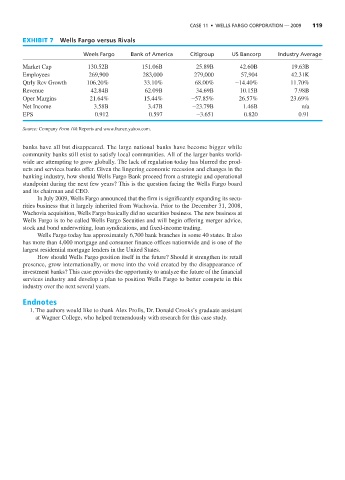
              EXHIBIT 7   Wells Fargo versus Rivals
                                  Weels Fargo    Bank of America     Citigroup    US Bancorp     Industry Average

              Market Cap           130.52B           151.06B           25.89B        42.60B           19.63B
              Employees            269,900           283,000          279,000        57,904           42.31K
              Qtrly Rev Growth     106.20%           33.10%           68.00%       -14.40%           11.70%
              Revenue               42.84B            62.09B           34.69B        10.15B            7.98B
              Oper Margins          21.64%           15.44%          -57.85%         26.57%          23.69%
              Net Income             3.58B             3.47B         -23.79B          1.46B              n/a
              EPS                    0.912             0.597           -3.651         0.820             0.91

              Source: Company Form 10k Reports and www.france.yahoo.com.

              banks have all but disappeared. The large national banks have become bigger while
              community banks still exist to satisfy local communities. All of the larger banks world-
              wide are attempting to grow globally. The lack of regulation today has blurred the prod-
              ucts and services banks offer. Given the lingering economic recession and changes in the
              banking industry, how should Wells Fargo Bank proceed from a strategic and operational
              standpoint during the next few years? This is the question facing the Wells Fargo board
              and its chairman and CEO.
                  In July 2009, Wells Fargo announced that the firm is significantly expanding its secu-
              rities business that it largely inherited from Wachovia. Prior to the December 31, 2008,
              Wachovia acquisition, Wells Fargo basically did no securities business. The new business at
              Wells Fargo is to be called Wells Fargo Secuities and will begin offering merger advice,
              stock and bond underwriting, loan syndications, and fixed-income trading.
                  Wells Fargo today has approximately 6,700 bank branches in some 40 states. It also
              has more than 4,000 mortgage and consumer finance offices nationwide and is one of the
              largest residential mortgage lenders in the United States.
                  How should Wells Fargo position itself in the future? Should it strengthen its retail
              presence, grow internationally, or move into the void created by the disappearance of
              investment banks? This case provides the opportunity to analyze the future of the financial
              services industry and develop a plan to position Wells Fargo to better compete in this
              industry over the next several years.

              Endnotes
                1. The authors would like to thank Alex Profis, Dr. Donald Crooks’s graduate assistant
                  at Wagner College, who helped tremendously with research for this case study.

