


Page 525 -
P. 525
CASE 12 • KRISPY KREME DOUGHNUTS  (KKD) — 2009  121

              high-quality southern-style doughnuts freshly baked in an observable oven was a concept
              that generated great interest. Opportunities for this hot brand seemed endless. KKD
              opened its first store in Canada in 2001. By 2004 Krispy Kreme was also operating stores
              in Australia and South Korea.
                  The year 2004 began a period of steep decline for Krispy Kreme. Early that year,
              Krispy Kreme announced that it had missed its quarterly earnings forecast and posted
              its first loss ever. The company blamed a diet-conscious public pursuing the low-
              carbohydrate Atkins diet for its problems. The stock price plunged from $40 per share
              to under $10.
                  Since 2005, Krispy Kreme has gone through a period of contraction. In Arizona and
              New Mexico, the main franchisee filed for bankruptcy closing all the Krispy Kreme
              stores. In 2008, another franchisee opened some stores in those states. In 2006, Krispy
              Kreme terminated the franchise license of Great Circle Family Foods that operated 28
              stores in California. While the dispute was settled, Great Circle filed for Chapter 11 bank-
              ruptcy in 2007. Sheetz, a large convenience store chain on the East Coast and one of
              Krispy Kreme’s largest customers, quit buying doughnuts in 2008 because it decided to
              open its own kitchen. Finally, international outlets shrunk with stores in Canada and Hong
              Kong shut down.
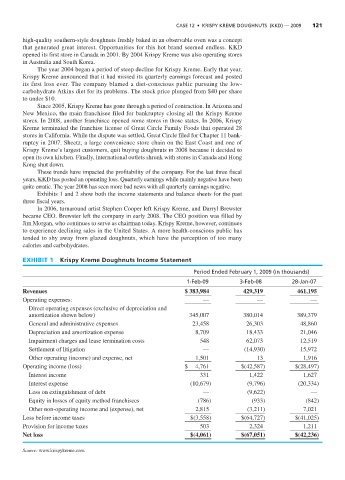
                  These trends have impacted the profitability of the company. For the last three fiscal
              years, KKD has posted an operating loss. Quarterly earnings while mainly negative have been
              quite erratic. The year 2008 has seen more bad news with all quarterly earnings negative.
                  Exhibits 1 and 2 show both the income statements and balance sheets for the past
              three fiscal years.
                  In 2006, turnaround artist Stephen Cooper left Krispy Kreme, and Darryl Brewster
              became CEO. Brewster left the company in early 2008. The CEO position was filled by
              Jim Morgan, who continues to serve as chairman today. Krispy Kreme, however, continues
              to experience declining sales in the United States. A more health-conscious public has
              tended to shy away from glazed doughnuts, which have the perception of too many
              calories and carbohydrates.
              EXHIBIT 1   Krispy Kreme Doughnuts Income Statement

                                                                      Period Ended February 1, 2009 (in thousands)
                                                                   1-Feb-09          3-Feb-08         28-Jan-07
              Revenues                                             $ 383,984          429,319           461,195
              Operating expenses:                                        —                 —                —
                Direct operating expenses (exclusive of depreciation and
                amortization shown below)                           345,007           380,014           389,379
                General and administrative expenses                  23,458            26,303            48,860
                Depreciation and amortization expense                 8,709            18,433            21,046
                Impairment charges and lease termination costs          548            62,073            12,519
                Settlement of litigation                                 —            (14,930)           15,972
                Other operating (income) and expense, net             1,501               13              1,916
              Operating income (loss)                              $     4,761       $(42,587)         $(28,497)
                Interest income                                         331             1,422             1,627
                Interest expense                                     (10,679)          (9,796)          (20,334)
                Loss on extinguishment of debt                           —             (9,622)              —
                Equity in losses of equity method franchisees          (786)             (933)             (842)
                Other non-operating income and (expense), net         2,815            (3,211)            7,021
              Loss before income taxes                               $(3,558)        $(64,727)         $(41,025)
              Provision for income taxes                                503             2,324             1,211
              Net loss                                               $(4,061)        $(67,051)         $(42,236)


              Source: www.krispykreme.com.

