


Page 312 - Structural Steel Designers Handbook AISC, AASHTO, AISI, ASTM, and ASCE-07 Design Standards
P. 312
Brockenbrough_Ch06.qxd  9/29/05  5:15 PM  Page 6.34


                                                 DESIGN OF BUILDING MEMBERS


                   6.34  CHAPTER SIX

                                                    4
                               W14 × 426 with I cx = 6600 in will be selected for the column. At the top of the column, where there
                               is no column above the floor, the relative column–beam stiffness is
                                                                     /(13
                                                           IL )
                                                     G =  ∑(/  c  =  6600 12  − ) 3  = . 049
                                                            c
                                                      A
                                                           IL )
                                                         ∑(/         112 .8
                                                           b  b
                               At the column bottom, with a W14 × 426 column below,
                                                         IL )
                                                                            3
                                                                      12
                                                   G =  ∑(/  c  =  2  × 6600 /(13 − )  = .098
                                                          c
                                                    B
                                                       ∑(/  b       112 .8
                                                         IL )
                                                          b
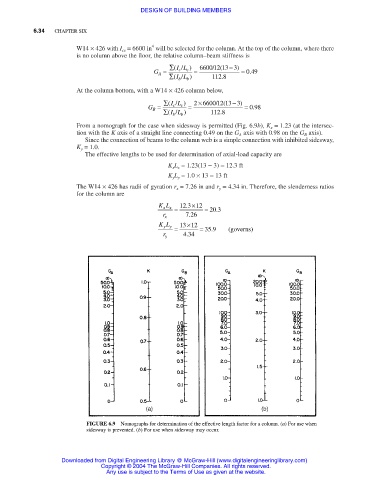
                               From a nomograph for the case when sidesway is permitted (Fig. 6.9b), K x = 1.23 (at the intersec-
                               tion with the K axis of a straight line connecting 0.49 on the G A axis with 0.98 on the G B axis).
                                 Since the connection of beams to the column web is a simple connection with inhibited sidesway,
                               K y = 1.0.
                                 The effective lengths to be used for determination of axial-load capacity are
                                                         K x L x = 1.23(13 − 3) = 12.3 ft
                                                         K y L y = 1.0 × 13 = 13 ft
                               The W14 × 426 has radii of gyration r x = 7.26 in and r y = 4.34 in. Therefore, the slenderness ratios
                               for the column are
                                                      KL  =  12 3 .  ×12  = 20 3 .
                                                       xx
                                                              .
                                                       r x   726
                                                      KL  =  13 ×12  = 35 9 .  (governs)
                                                       yy
                                                              .
                                                       r y   434


                                  FIGURE 6.9  Nomographs for determination of the effective length factor for a column. (a) For use when
                                  sidesway is prevented. (b) For use when sidesway may occur.


                           Downloaded from Digital Engineering Library @ McGraw-Hill (www.digitalengineeringlibrary.com)
                                      Copyright © 2004 The McGraw-Hill Companies. All rights reserved.
                                       Any use is subject to the Terms of Use as given at the website.

