


Page 310 - Structural Steel Designers Handbook AISC, AASHTO, AISI, ASTM, and ASCE-07 Design Standards
P. 310
Brockenbrough_Ch06.qxd  9/29/05  5:15 PM  Page 6.32


                                                 DESIGN OF BUILDING MEMBERS


                   6.32  CHAPTER SIX

                               number of studs is 13.25 × 12/10.42 − 16 =−0.74. Since the result is negative, use on the left
                               the maximum permissible stud spacing of 36 in. On the right, the required number of studs is
                               16.75 × 12/13.53 − 10 = 4.85. Use 5 studs. The spacing should not exceed 12(16.75 − 10)/5 = 16.2 in.
                               Specification of one spacing for the middle segment, however, is more practical. Accordingly,
                               the number of studs between the two concentrated loads would be based on the smallest spacing
                               on either side of the point of maximum moment: 10 × 12/16.2 = 7.4. Use 8 studs spaced 15 in
                               center to center.
                                 It may be preferable to specify the total number of studs placed on the beam based on one uni-
                               form spacing. The spacing required to develop the maximum moment on either side of its location
                               and between each concentrated load and a support is 7.77 in, as calculated previously. For this spac-
                               ing over the 30-ft span, the total number of studs required is 30 × 12/7.77 = 46.3. Use 48 studs (the
                               next even number).
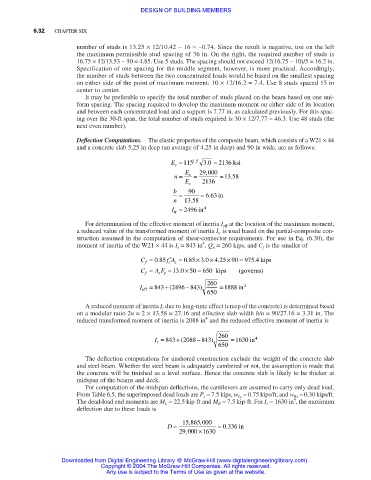
                               Deflection Computations. The elastic properties of the composite beam, which consists of a W21 × 44
                               and a concrete slab 5.25 in deep (an average of 4.25 in deep) and 90 in wide, are as follows:
                                                         E = 115 15 .  3 0 .  = 2136 ksi
                                                          c
                                                                   ,
                                                          n =  E s  =  29 000  = 13 58
                                                                          .
                                                             E c  2136
                                                          b   90
                                                            =     = 663 in
                                                                    .
                                                          n  13 58
                                                               .
                                                          I = 2496 in 4
                                                          tr
                                 For determination of the effective moment of inertia I eff at the location of the maximum moment,
                               a reduced value of the transformed moment of inertia I tr is used based on the partial-composite con-
                               struction assumed in the computation of shear-connector requirements. For use in Eq. (6.30), the
                                                                  4
                               moment of inertia of the W21 × 44 is I s = 843 in , Q n = 260 kips, and C f is the smaller of
                                                                         ×
                                                      .
                                                                × .
                                                                    × .
                                                 C = 085 f A ′  = 085 30 425 90  = 9754 . kips
                                                              .
                                                         cc
                                                  f
                                                 C =  A F = 13 0 50  = 650 kips  (governs)
                                                             ×
                                                            .
                                                      sy
                                                  f
                                                 I eff  = 843 (  −  260  = 1888 in  4
                                                        + 2496 843)
                                                                   650
                                 A reduced moment of inertia I r due to long-time effect (creep of the concrete) is determined based
                               on a modular ratio 2n = 2 × 13.58 = 27.16 and effective slab width b/n = 90/27.16 = 3.31 in. The
                                                                   4
                               reduced transformed moment of inertia is 2088 in and the reduced effective moment of inertia is
                                                                 −
                                                     I = 843 + 2088 843)  260  = 1630 in  4
                                                            (
                                                     r
                                                                       650
                                 The deflection computations for unshored construction exclude the weight of the concrete slab
                               and steel beam. Whether the steel beam is adequately cambered or not, the assumption is made that
                               the concrete will be finished as a level surface. Hence the concrete slab is likely to be thicker at
                               midspan of the beams and deck.
                                 For computation of the midspan deflections, the cantilevers are assumed to carry only dead load.
                               From Table 6.5, the superimposed dead loads are P s = 7.5 kips, w Ls = 0.75 kips/ft, and w Rs = 0.30 kips/ft.
                                                                                            4
                               The dead-load end moments are M L = 22.5 kip⋅ft and M R = 7.5 kip⋅ft. For I r = 1630 in , the maximum
                               deflection due to these loads is
                                                                 ,
                                                              ,
                                                        D =  15 865 000  = 0 336 in
                                                                         .
                                                             ,
                                                            29 000 ×1630
                           Downloaded from Digital Engineering Library @ McGraw-Hill (www.digitalengineeringlibrary.com)
                                      Copyright © 2004 The McGraw-Hill Companies. All rights reserved.
                                       Any use is subject to the Terms of Use as given at the website.

