


Page 324 - Structural Steel Designers Handbook AISC, AASHTO, AISI, ASTM, and ASCE-07 Design Standards
P. 324
Brockenbrough_Ch07.qxd  9/29/05  5:16 PM  Page 7.8


                                                  FLOOR AND ROOF SYSTEMS


                   7.8  CHAPTER SEVEN

                               distribution system. When the topping is designed to act compositely with the plank, however,
                               careful consideration must be given to the effects of these embedded items.

                               Dead-Load Deflection of Concrete Plank. In design of prestressed-concrete planks, the prestressing
                               load balances a substantial portion of the dead load. As a result, relatively small dead-load deflections
                               occur. For planks subjected to significant superimposed dead-load conditions of a sustained nature,
                               for example, perimeter plank supporting an exterior masonry wall, additional prestressing to com-
                               pensate for the added dead load, or some other stiffening method, is required to prevent large initial
                               and creep deflections of the plank.

                               Diaphragm Action of Concrete-Plank Systems.  The diaphragm action of a floor deck composed
                               of precast-concrete planks can be enhanced by making field-welded connections between steel
                               embedments located intermittently along the shear keys of adjacent planks. Additional diaphragm
                               strength may be required in certain situations, such as when large floor-deck openings are present
                               (see “Diaphragm Action of Metal-Deck Systems” in Art. 7.1).

                               Attachments of Concrete Plank to Framing.  Precast-concrete planks are attached to and provide
                               lateral bracing for supporting steel framing. A typical method of attachment is a field-welded con-
                               nection between the supporting steel and steel embedments in the precast planks.


                   7.3 CAST-IN-PLACE CONCRETE SLABS

                               Use of cast-in-place concrete for floor decks in steel-framed construction is a traditional approach
                               that is seldom used today because of the advent of metal deck and spray-on fire protection. For one
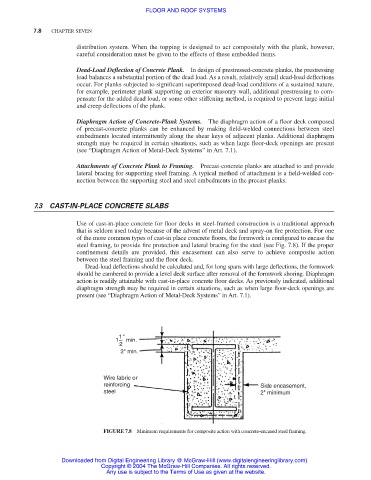
                               of the more common types of cast-in place concrete floors, the formwork is configured to encase the
                               steel framing, to provide fire protection and lateral bracing for the steel (see Fig. 7.8). If the proper
                               confinement details are provided, this encasement can also serve to achieve composite action
                               between the steel framing and the floor deck.
                                 Dead-load deflections should be calculated and, for long spans with large deflections, the formwork
                               should be cambered to provide a level deck surface after removal of the formwork shoring. Diaphragm
                               action is readily attainable with cast-in-place concrete floor decks. As previously indicated, additional
                               diaphragm strength may be required in certain situations, such as when large floor-deck openings are
                               present (see “Diaphragm Action of Metal-Deck Systems” in Art. 7.1).


                                           1"
                                          1–  min.
                                           2
                                           2" min.


                                       Wire fabric or
                                       reinforcing                                Side encasement,
                                       steel                                      2" minimum


                                       FIGURE 7.8 Minimum requirements for composite action with concrete-encased steel framing.


                           Downloaded from Digital Engineering Library @ McGraw-Hill (www.digitalengineeringlibrary.com)
                                      Copyright © 2004 The McGraw-Hill Companies. All rights reserved.
                                       Any use is subject to the Terms of Use as given at the website.

