


Page 328 - Structural Steel Designers Handbook AISC, AASHTO, AISI, ASTM, and ASCE-07 Design Standards
P. 328
Brockenbrough_Ch07.qxd  9/29/05  5:16 PM  Page 7.12


                                                  FLOOR AND ROOF SYSTEMS


                   7.12  CHAPTER SEVEN

                   7.6 WOOD-FIBER PLANKS

                               Planks formed of wood fibers bonded with portland cement provide a lightweight roof deck with
                               insulating and acoustical properties. The typical density of this material ranges between 30 and
                                    3
                               40 lb/ft . Some plank types have diaphragm capacities. When used as part of an approved ceiling
                               assembly, many planks can achieve a fire rating. This type of roof deck system is commonly used
                               for gymnasiums and similar facilities because of its superior acoustical properties.
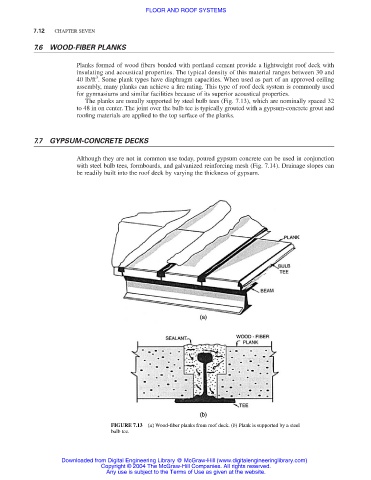
                                 The planks are usually supported by steel bulb tees (Fig. 7.13), which are nominally spaced 32
                               to 48 in on center. The joint over the bulb tee is typically grouted with a gypsum-concrete grout and
                               roofing materials are applied to the top surface of the planks.


                   7.7 GYPSUM-CONCRETE DECKS

                               Although they are not in common use today, poured gypsum concrete can be used in conjunction
                               with steel bulb tees, formboards, and galvanized reinforcing mesh (Fig. 7.14). Drainage slopes can
                               be readily built into the roof deck by varying the thickness of gypsum.


                                         FIGURE 7.13  (a) Wood-fiber planks from roof deck. (b) Plank is supported by a steel
                                         bulb tee.


                           Downloaded from Digital Engineering Library @ McGraw-Hill (www.digitalengineeringlibrary.com)
                                      Copyright © 2004 The McGraw-Hill Companies. All rights reserved.
                                       Any use is subject to the Terms of Use as given at the website.

