


Page 333 - Structural Steel Designers Handbook AISC, AASHTO, AISI, ASTM, and ASCE-07 Design Standards
P. 333
Brockenbrough_Ch07.qxd  9/29/05  5:17 PM  Page 7.17


                                                     FLOOR AND ROOF SYSTEMS


                                                                                 FLOOR AND ROOF SYSTEMS  7.17


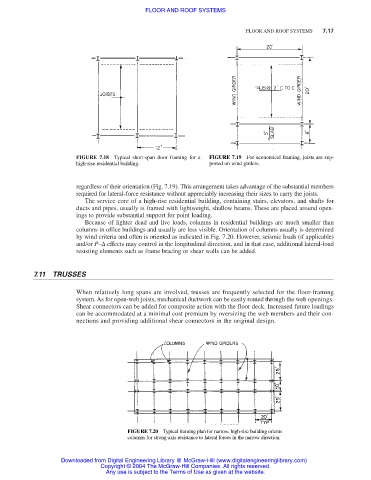
                                  FIGURE 7.18  Typical short-span floor framing for a  FIGURE 7.19  For economical framing, joists are sup-
                                  high-rise residential building.      ported on wind girders.

                                  regardless of their orientation (Fig. 7.19). This arrangement takes advantage of the substantial members
                                  required for lateral-force resistance without appreciably increasing their sizes to carry the joists.
                                    The service core of a high-rise residential building, containing stairs, elevators, and shafts for
                                  ducts and pipes, usually is framed with lightweight, shallow beams. These are placed around open-
                                  ings to provide substantial support for point loading.
                                    Because of lighter dead and live loads, columns in residential buildings are much smaller than
                                  columns in office buildings and usually are less visible. Orientation of columns usually is determined
                                  by wind criteria and often is oriented as indicated in Fig. 7.20. However, seismic loads (if applicable)
                                  and/or P–∆ effects may control in the longitudinal direction, and in that case, additional lateral-load
                                  resisting elements such as frame bracing or shear walls can be added.


                      7.11 TRUSSES

                                  When relatively long spans are involved, trusses are frequently selected for the floor-framing
                                  system. As for open-web joists, mechanical ductwork can be easily routed through the web openings.
                                  Shear connectors can be added for composite action with the floor deck. Increased future loadings
                                  can be accommodated at a minimal cost premium by oversizing the web members and their con-
                                  nections and providing additional shear connectors in the original design.


                                                FIGURE 7.20 Typical framing plan for narrow, high-rise building orients
                                                columns for strong-axis resistance to lateral forces in the narrow direction.


                              Downloaded from Digital Engineering Library @ McGraw-Hill (www.digitalengineeringlibrary.com)
                                         Copyright © 2004 The McGraw-Hill Companies. All rights reserved.
                                          Any use is subject to the Terms of Use as given at the website.

