


Page 332 - Structural Steel Designers Handbook AISC, AASHTO, AISI, ASTM, and ASCE-07 Design Standards
P. 332
Brockenbrough_Ch07.qxd  9/29/05  5:17 PM  Page 7.16


                                                  FLOOR AND ROOF SYSTEMS


                   7.16  CHAPTER SEVEN


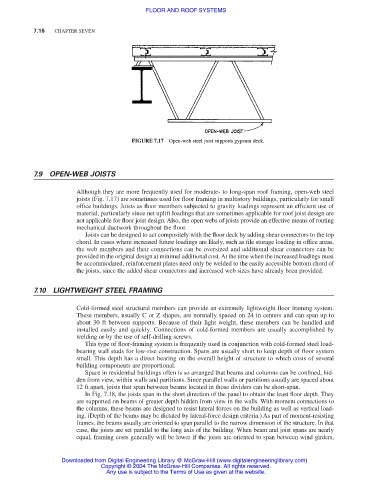
                                              FIGURE 7.17  Open-web steel joist supports gypsum deck.


                   7.9 OPEN-WEB JOISTS

                               Although they are more frequently used for moderate- to long-span roof framing, open-web steel
                               joists (Fig. 7.17) are sometimes used for floor framing in multistory buildings, particularly for small
                               office buildings. Joists as floor members subjected to gravity loadings represent an efficient use of
                               material, particularly since net uplift loadings that are sometimes applicable for roof joist design are
                               not applicable for floor joist design. Also, the open webs of joists provide an effective means of routing
                               mechanical ductwork throughout the floor.
                                 Joists can be designed to act compositely with the floor deck by adding shear connectors to the top
                               chord. In cases where increased future loadings are likely, such as file storage loading in office areas,
                               the web members and their connections can be oversized and additional shear connectors can be
                               provided in the original design at minimal additional cost. At the time when the increased loadings must
                               be accommodated, reinforcement plates need only be welded to the easily accessible bottom chord of
                               the joists, since the added shear connectors and increased web sizes have already been provided.


                   7.10 LIGHTWEIGHT STEEL FRAMING

                               Cold-formed steel structural members can provide an extremely lightweight floor framing system.
                               These members, usually C or Z shapes, are normally spaced on 24 in centers and can span up to
                               about 30 ft between supports. Because of their light weight, these members can be handled and
                               installed easily and quickly. Connections of cold-formed members are usually accomplished by
                               welding or by the use of self-drilling screws.
                                 This type of floor-framing system is frequently used in conjunction with cold-formed steel load-
                               bearing wall studs for low-rise construction. Spans are usually short to keep depth of floor system
                               small. This depth has a direct bearing on the overall height of structure to which costs of several
                               building components are proportional.
                                 Space in residential buildings often is so arranged that beams and columns can be confined, hid-
                               den from view, within walls and partitions. Since parallel walls or partitions usually are spaced about
                               12 ft apart, joists that span between beams located in those dividers can be short-span.
                                 In Fig. 7.18, the joists span in the short direction of the panel to obtain the least floor depth. They
                               are supported on beams of greater depth hidden from view in the walls. With moment connections to
                               the columns, these beams are designed to resist lateral forces on the building as well as vertical load-
                               ing. (Depth of the beams may be dictated by lateral-force design criteria.) As part of moment-resisting
                               frames, the beams usually are oriented to span parallel to the narrow dimension of the structure. In that
                               case, the joists are set parallel to the long axis of the building. When beam and joist spans are nearly
                               equal, framing costs generally will be lower if the joists are oriented to span between wind girders,


                           Downloaded from Digital Engineering Library @ McGraw-Hill (www.digitalengineeringlibrary.com)
                                      Copyright © 2004 The McGraw-Hill Companies. All rights reserved.
                                       Any use is subject to the Terms of Use as given at the website.

