


Page 350 - Structural Steel Designers Handbook AISC, AASHTO, AISI, ASTM, and ASCE-07 Design Standards
P. 350
Brockenbrough_Ch08.qxd  9/29/05  5:21 PM  Page 8.4


                                                    LATERAL-FORCE DESIGN


                   8.4  CHAPTER EIGHT

                               internal pressure or a pressure reduction as illustrated in Fig. 8.1c and d. This internal pressure
                               change depends on the size of the openings for all walls and the geometry of the structures. Slopes
                               of roofs may affect the pressure distribution as illustrated in Fig. 8.1e. In general, downward or
                               inward pressures are expected on the windward side, while upward or outward pressure differential
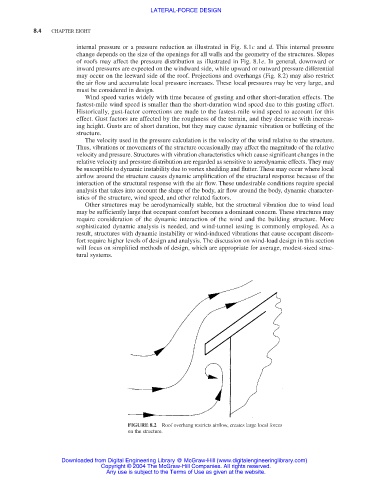
                               may occur on the leeward side of the roof. Projections and overhangs (Fig. 8.2) may also restrict
                               the air flow and accumulate local pressure increases. These local pressures may be very large, and
                               must be considered in design.
                                 Wind speed varies widely with time because of gusting and other short-duration effects. The
                               fastest-mile wind speed is smaller than the short-duration wind speed due to this gusting effect.
                               Historically, gust-factor corrections are made to the fastest-mile wind speed to account for this
                               effect. Gust factors are affected by the roughness of the terrain, and they decrease with increas-
                               ing height. Gusts are of short duration, but they may cause dynamic vibration or buffeting of the
                               structure.
                                 The velocity used in the pressure calculation is the velocity of the wind relative to the structure.
                               Thus, vibrations or movements of the structure occasionally may affect the magnitude of the relative
                               velocity and pressure. Structures with vibration characteristics which cause significant changes in the
                               relative velocity and pressure distribution are regarded as sensitive to aerodynamic effects. They may
                               be susceptible to dynamic instability due to vortex shedding and flutter. These may occur where local
                               airflow around the structure causes dynamic amplification of the structural response because of the
                               interaction of the structural response with the air flow. These undesirable conditions require special
                               analysis that takes into account the shape of the body, air flow around the body, dynamic character-
                               istics of the structure, wind speed, and other related factors.
                                 Other structures may be aerodynamically stable, but the structural vibration due to wind load
                               may be sufficiently large that occupant comfort becomes a dominant concern. These structures may
                               require consideration of the dynamic interaction of the wind and the building structure. More
                               sophisticated dynamic analysis is needed, and wind-tunnel testing is commonly employed. As a
                               result, structures with dynamic instability or wind-induced vibrations that cause occupant discom-
                               fort require higher levels of design and analysis. The discussion on wind-load design in this section
                               will focus on simplified methods of design, which are appropriate for average, modest-sized struc-
                               tural systems.


                                             FIGURE 8.2 Roof overhang restricts airflow, creates large local forces
                                             on the structure.


                           Downloaded from Digital Engineering Library @ McGraw-Hill (www.digitalengineeringlibrary.com)
                                      Copyright © 2004 The McGraw-Hill Companies. All rights reserved.
                                       Any use is subject to the Terms of Use as given at the website.

