


Page 354 - Structural Steel Designers Handbook AISC, AASHTO, AISI, ASTM, and ASCE-07 Design Standards
P. 354
Brockenbrough_Ch08.qxd  9/29/05  5:21 PM  Page 8.8


                                                    LATERAL-FORCE DESIGN


                   8.8  CHAPTER EIGHT

                               predicted for a building for a given earthquake acceleration. The structure is initially elastic, and so
                               the linear-elastic force-deflection behavior is plotted in the figure. Large infrequent earthquakes
                               require large seismic design forces for the elastic condition, and it is more economical to design a
                               building that provides reasonable ductility but significantly reduced building resistance. This nominal
                               building performance is plotted as a pushover force–deflection curve in the figure. The equal-
                               displacement hypothesis postulates that the maximum inelastic displacement will be no larger than
                               the maximum displacement expected if the structure remains elastic. This hypothesis has been examined
                               by numerous research studies, and it has been shown to be generally valid if the building is not exces-
                               sively weak, does not have a very short period, and does not exhibit poor inelastic performance. As a
                               consequence of this observation, seismic design provisions establish reduced seismic design forces and
                               ductile detailing requirements. The design procedure gives all appearances of being a force-based design
                               method, but it is really an inelastic deformation design method based on the equal-displacement
                               hypothesis combined with the detailing requirements of the AISC Seismic Design Provisions.

                               Seismic Base Shear.  The equivalent static force method is the more commonly used method and
                               is described here. The dynamic method is discussed in greater detail in Art. 8.5. The equivalent sta-
                               tic force method defines the static shear, V, at the base of the building as
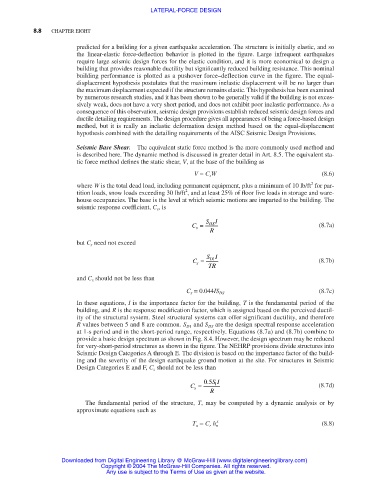
                                                                V = C s W                           (8.6)
                                                                                                 2
                               where W is the total dead load, including permanent equipment, plus a minimum of 10 lb/ft for par-
                                                             2
                               tition loads, snow loads exceeding 30 lb/ft , and at least 25% of floor live loads in storage and ware-
                               house occupancies. The base is the level at which seismic motions are imparted to the building. The
                               seismic response coefficient, C S , is
                                                               C =  SI                             (8.7a)
                                                                    DS
                                                                s
                                                                    R
                               but C S need not exceed
                                                               C =  SI                             (8.7b)
                                                                    D1
                                                                 s
                                                                    TR
                               and C S should not be less than
                                                                                                   (8.7c)
                                                              C S = 0.044IS DS
                               In these equations, I is the importance factor for the building, T is the fundamental period of the
                               building, and R is the response modification factor, which is assigned based on the perceived ductil-
                               ity of the structural system. Steel structural systems can offer significant ductility, and therefore
                               R values between 5 and 8 are common. S D1 and S DS are the design spectral response acceleration
                               at 1-s period and in the short-period range, respectively. Equations (8.7a) and (8.7b) combine to
                               provide a basic design spectrum as shown in Fig. 8.4. However, the design spectrum may be reduced
                               for very-short-period structures as shown in the figure. The NEHRP provisions divide structures into
                               Seismic Design Categories A through E. The division is based on the importance factor of the build-
                               ing and the severity of the design earthquake ground motion at the site. For structures in Seismic
                               Design Categories E and F, C S should not be less than

                                                               C =  05 .  SI                       (8.7d)
                                                                      1
                                                                s
                                                                    R
                                 The fundamental period of the structure,  T, may be computed by a dynamic analysis or by
                               approximate equations such as
                                                                      x
                                                               T a = C r h n                        (8.8)


                           Downloaded from Digital Engineering Library @ McGraw-Hill (www.digitalengineeringlibrary.com)
                                      Copyright © 2004 The McGraw-Hill Companies. All rights reserved.
                                       Any use is subject to the Terms of Use as given at the website.

