


Page 357 - Structural Steel Designers Handbook AISC, AASHTO, AISI, ASTM, and ASCE-07 Design Standards
P. 357
Brockenbrough_Ch08.qxd  9/29/05  5:21 PM  Page 8.11


                                                       LATERAL-FORCE DESIGN


                                                                                   LATERAL-FORCE DESIGN  8.11

                                  behavior of the structure, R ranges from 1.25 to 8. The largest values of R are used for ductile struc-
                                  tural systems that can dissipate large amounts of energy and can sustain large inelastic deformations.
                                  The smallest values are intended to assure nearly elastic behavior when the overstrength normally
                                  achieved in design is considered.
                                    Special steel moment-resisting frames have historically been regarded as one of the most ductile
                                  structural systems and are assigned  R = 8. Moment-resisting steel frames are three-dimensional
                                  frames in which the members and joints are capable of resisting lateral forces on the structure pri-
                                  marily by flexure. While this structural system is still highly regarded, the performance of special-
                                  moment frames during the January 17, 1994, Northridge earthquake raised serious questions as to
                                  the performance of these structures, and this will be discussed in some detail in Art. 8.6. Ordinary
                                  moment frames are designed to less stringent ductility criteria, and R = 3.5.
                                    For steel eccentric braced frames (Fig. 8.5), at least one end of each diagonal brace intersects a
                                  beam at a point away from the column–girder joint or from an adjacent brace–girder joint. This
                                  eccentric intersection forms a link beam, which must be designed to yield in shear or bending to pre-
                                  vent buckling of the brace. This system is also quite ductile, and values as large as R = 8.0 are also
                                  permitted.
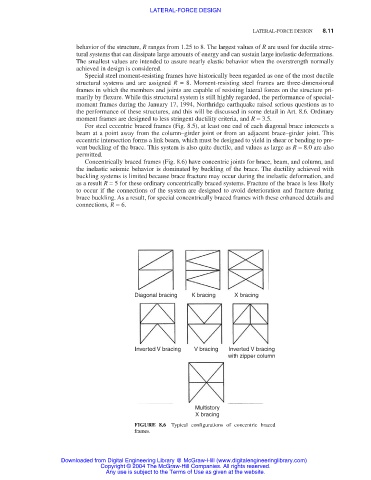
                                    Concentrically braced frames (Fig. 8.6) have concentric joints for brace, beam, and column, and
                                  the inelastic seismic behavior is dominated by buckling of the brace. The ductility achieved with
                                  buckling systems is limited because brace fracture may occur during the inelastic deformation, and
                                  as a result R = 5 for these ordinary concentrically braced systems. Fracture of the brace is less likely
                                  to occur if the connections of the system are designed to avoid deterioration and fracture during
                                  brace buckling. As a result, for special concentrically braced frames with these enhanced details and
                                  connections, R = 6.


                                                  Diagonal bracing  K bracing  X bracing


                                                  Inverted V bracing  V bracing  Inverted V bracing
                                                                            with zipper column


                                                                   Multistory
                                                                   X bracing
                                                  FIGURE 8.6  Typical configurations of concentric braced
                                                  frames.


                              Downloaded from Digital Engineering Library @ McGraw-Hill (www.digitalengineeringlibrary.com)
                                         Copyright © 2004 The McGraw-Hill Companies. All rights reserved.
                                          Any use is subject to the Terms of Use as given at the website.

