


Page 353 - Structural Steel Designers Handbook AISC, AASHTO, AISI, ASTM, and ASCE-07 Design Standards
P. 353
Brockenbrough_Ch08.qxd  9/29/05  5:21 PM  Page 8.7


                                                       LATERAL-FORCE DESIGN


                                                                                    LATERAL-FORCE DESIGN  8.7

                                  since the 1970s. There has been considerable similarity between the UBC and NEHRP recommenda-
                                  tions, since the rationale is similar for both documents and many engineers participate in the develop-
                                  ment of both documents. However, there have also been differences in the detailed approach used by
                                  the UBC and NEHRP provisions. In recent years, efforts have been made to resolve these differences.
                                  Today, structural engineers have moved toward a unified national code, which is the International
                                  Building Code (IBC) maintained by the International Code Council, Falls Church, Virginia. The IBC
                                  today bases its seismic provisions on the NEHRP provisions, and it effectively adopts these provisions
                                  by reference to the “Minimum Design Loads for Buildings and Other Structures,” ASCE 7-02. Today
                                  this is the primary method for establishing earthquake design forces for buildings. The ASCE 7-05 seis-
                                  mic design provisions will be based on the 2003 NEHRP provisions.
                                    Seismic design is based on the concept of permitting significant inelastic deformations during
                                  large infrequent earthquakes while preventing building collapse and loss of life for building occu-
                                  pants. Careful detailing requirements are needed to assure this structural ductility and inelastic per-
                                  formance.  The  American Institute of Steel Construction (AISC) promulgates “Seismic Design
                                  Provisions for Structural Steel Buildings (2005)” to assure satisfactory inelastic performance. This
                                  document provides detailed design requirement for steel structures, which are then used in conjunc-
                                  tion with seismic design forces and deformations provided in the applicable building code, or ASCE 7
                                  standard. ASCE 7-05 was not available at the time of preparation of this chapter. Therefore, the seis-
                                  mic load procedures described here are based on the 2003 NEHRP provisions, which will provide
                                  the basis for ASCE 7-05, and AISC 2005 seismic provisions for structural detailing.


                      8.4 SEISMIC DESIGN LOADS

                                  The NEHRP and ASCE 7 provisions offer two methods for determining and distributing seismic
                                  design loads. One is the dynamic method, which is required to be used for a structure that is irregu-
                                  lar or of unusual proportions. The other specifies equivalent static forces and is the most widely used,
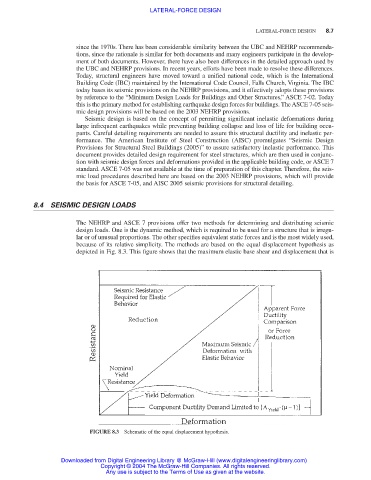
                                  because of its relative simplicity. The methods are based on the equal displacement hypothesis as
                                  depicted in Fig. 8.3. This figure shows that the maximum elastic base shear and displacement that is


                                      FIGURE 8.3  Schematic of the equal displacement hypothesis.


                              Downloaded from Digital Engineering Library @ McGraw-Hill (www.digitalengineeringlibrary.com)
                                         Copyright © 2004 The McGraw-Hill Companies. All rights reserved.
                                          Any use is subject to the Terms of Use as given at the website.

