


Page 388 - Structural Steel Designers Handbook AISC, AASHTO, AISI, ASTM, and ASCE-07 Design Standards
P. 388
Brockenbrough_Ch08.qxd  9/29/05  5:21 PM  Page 8.42


                                                    LATERAL-FORCE DESIGN


                   8.42  CHAPTER EIGHT


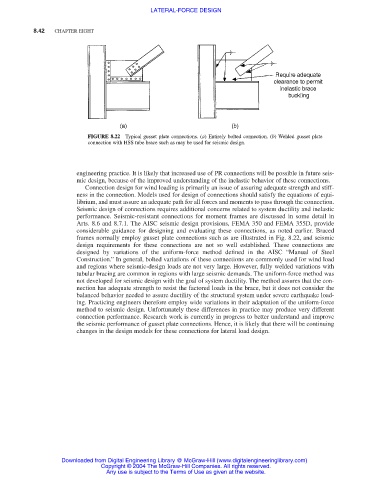
                                  FIGURE 8.22  Typical gusset plate connections. (a) Entirely bolted connection. (b) Welded gusset plate
                                  connection with HSS tube brace such as may be used for seismic design.


                               engineering practice. It is likely that increased use of PR connections will be possible in future seis-
                               mic design, because of the improved understanding of the inelastic behavior of these connections.
                                 Connection design for wind loading is primarily an issue of assuring adequate strength and stiff-
                               ness in the connection. Models used for design of connections should satisfy the equations of equi-
                               librium, and must assure an adequate path for all forces and moments to pass through the connection.
                               Seismic design of connections requires additional concerns related to system ductility and inelastic
                               performance. Seismic-resistant connections for moment frames are discussed in some detail in
                               Arts. 8.6 and 8.7.1. The AISC seismic design provisions, FEMA 350 and FEMA 355D, provide
                               considerable guidance for designing and evaluating these connections, as noted earlier. Braced
                               frames normally employ gusset plate connections such as are illustrated in Fig. 8.22, and seismic
                               design requirements for these connections are not so well established.  These connections are
                               designed by variations of the uniform-force method defined in the  AISC “Manual of Steel
                               Construction.” In general, bolted variations of these connections are commonly used for wind load
                               and regions where seismic-design loads are not very large. However, fully welded variations with
                               tubular bracing are common in regions with large seismic demands. The uniform-force method was
                               not developed for seismic design with the goal of system ductility. The method assures that the con-
                               nection has adequate strength to resist the factored loads in the brace, but it does not consider the
                               balanced behavior needed to assure ductility of the structural system under severe earthquake load-
                               ing. Practicing engineers therefore employ wide variations in their adaptation of the uniform-force
                               method to seismic design. Unfortunately these differences in practice may produce very different
                               connection performance. Research work is currently in progress to better understand and improve
                               the seismic performance of gusset plate connections. Hence, it is likely that there will be continuing
                               changes in the design models for these connections for lateral load design.


                           Downloaded from Digital Engineering Library @ McGraw-Hill (www.digitalengineeringlibrary.com)
                                      Copyright © 2004 The McGraw-Hill Companies. All rights reserved.
                                       Any use is subject to the Terms of Use as given at the website.

